

Old Stone, New Sun
Dartmoor / Heatwave / Shanks's Pony

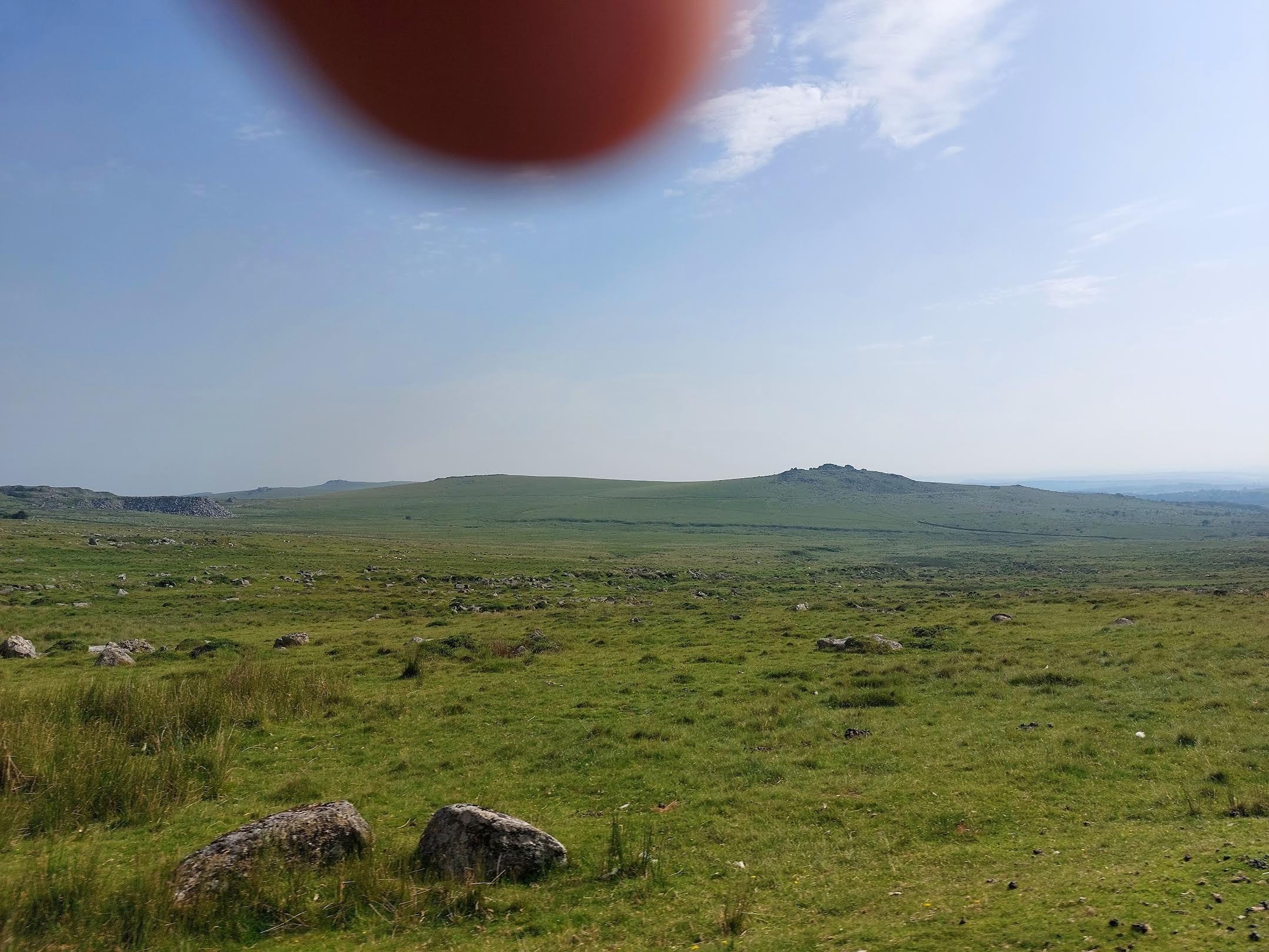
Heatwave, they call it— but that seems a misnomer. A wave to my mind is cold, refreshing, & transitory, whereas the heat of a heatwave is more like a blanket, or a cloud: all over, all around, enveloping, inescapable.1 Extreme heat renders the air a tangible element, like water. Being in it feels like being in a sauna without an exit, or like being the proverbial frog in the pot. 36.4° in Somerset today, 36.1° in Hampshire yesterday: the highest U.K. June temperatures of all time. (It’s 40° in Paris.) Other terms I’ve seen include Heat Dome & Atmospheric Lid. But these phrases are all too euphemistic, in the same way Global Warming is too gentle. Heat is an implacable antagonist. It feels personal, even though it isn’t— it’s just the piper come to be paid.2
It all feels worse because the U.K. is not designed for hot weather— quite the opposite, in fact. And extreme heat is stupefying as well as terrifying; it becomes hard to think, like being constantly smacked in the head. Emotionally, the only thing I can compare it to is the weather of my city (Wellington) when it goes rogue in the opposite direction— gale-force wind, relentless rain, sea coming into your house— when the hillsides are sliding & trees are falling, when you feel like a tiny animal infinitely shaken in the storm’s jaws… It goes on day & night, & when you’ve been trapped in the house by the storm for two days, three, it feels like a psychic assault, & you reach a state of desperation, an abject begging feeling, like please, please, stop.
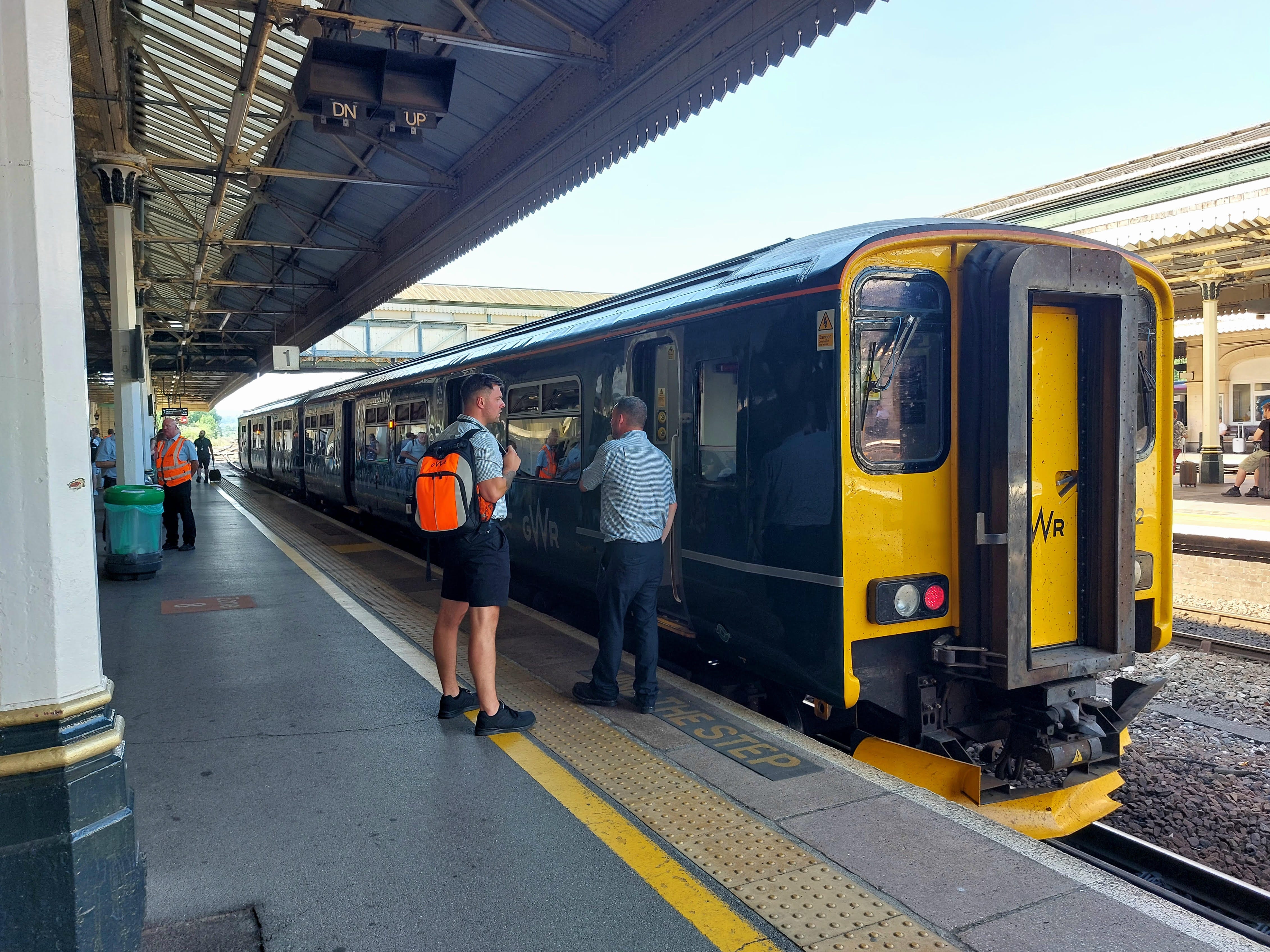
On my first night in Dartmoor I was still wakeful after everyone else had gone to bed. I’d been in trains for a fair bit of the day, the last a tiny two-carriage tin can on the branch line to Okehampton, & I was feeling restless.3 The light was beautiful, the waxing moon was rising, the bewitching landscape was calling me:
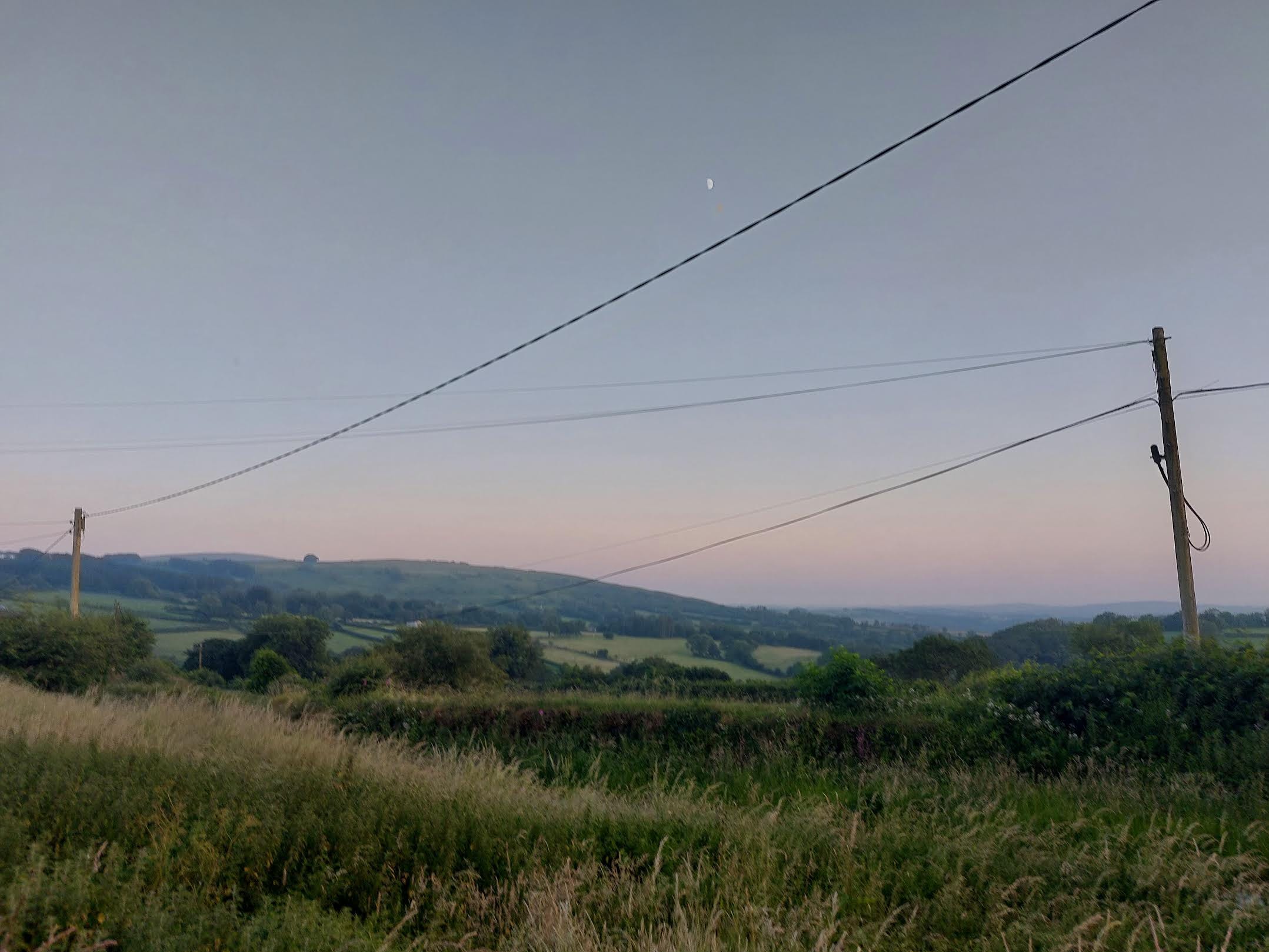
I asked the others the way, & Jonny put me on the right track— but it’s easy to find a river. I followed the path down like water. First through lush hedgerows,4 then onto a very rocky path like a dry stream bed— In Winter, I thought, it would be a stream: snow-melt, hence the exposure of the stones— hemmed in on both sides by walls & banks & trees, a kind of steeply sloping holloway. (I knew the hot weather was extremely uncharacteristic, so everywhere I went in Dartmoor I was trying to imagine the landscape in Winter, covered in snow.) I was taking photos with my camera, digging the lush half-dark, upping the ASA as dusk fell more & more deeply. Wooden gates, glimpsed green-velvet fields, a sheep or two, the sound of a horse; dark stones, moss, gnarly old twisted trees.
I turned left at a sign that said PUBLIC FOOTPATH (if one path is PUBLIC, does that mean the other is not? It’s all guesswork), crossed a wooden stile (smoothed to silkenness by much passage) & walked along by a small canal.
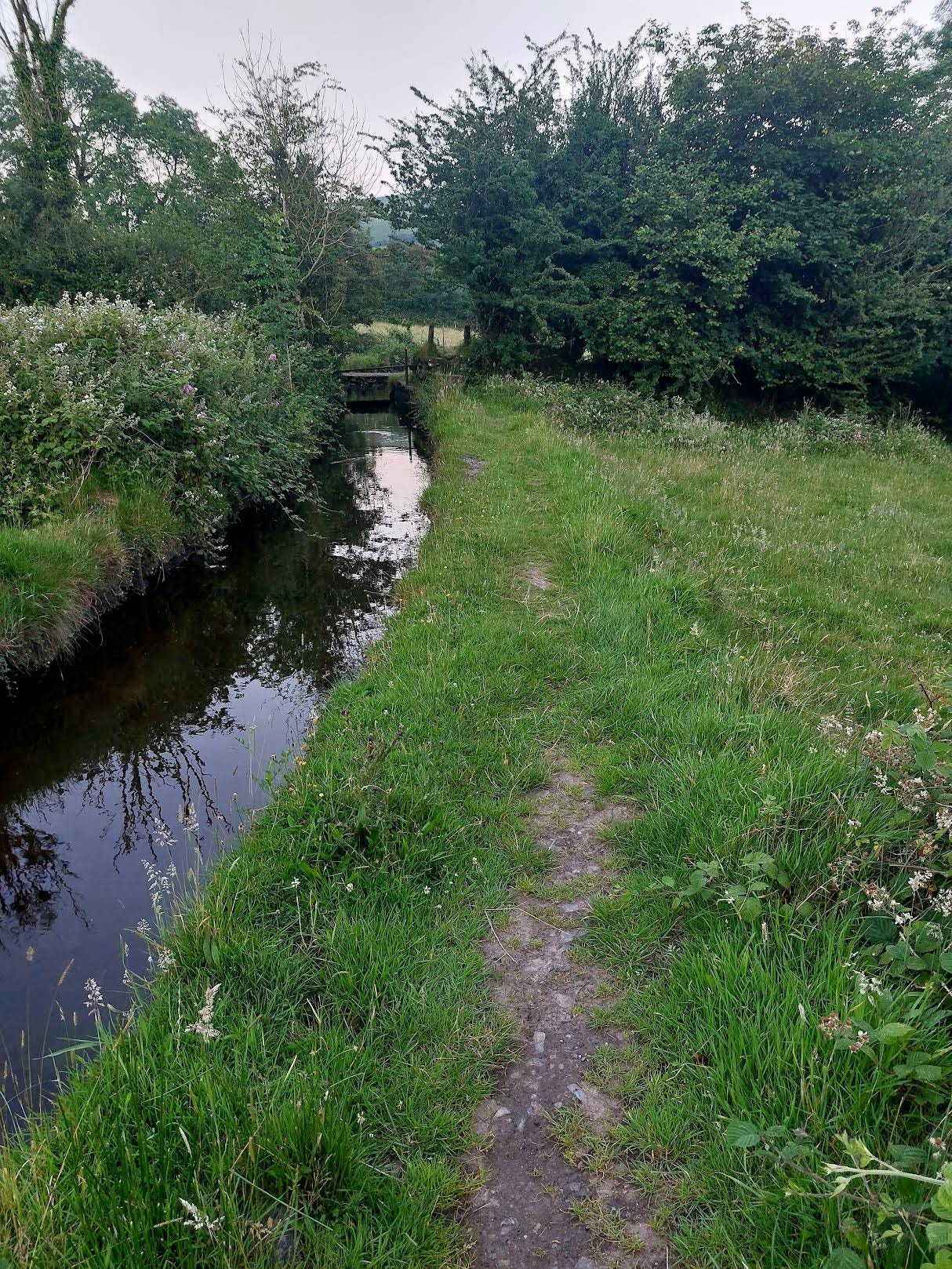
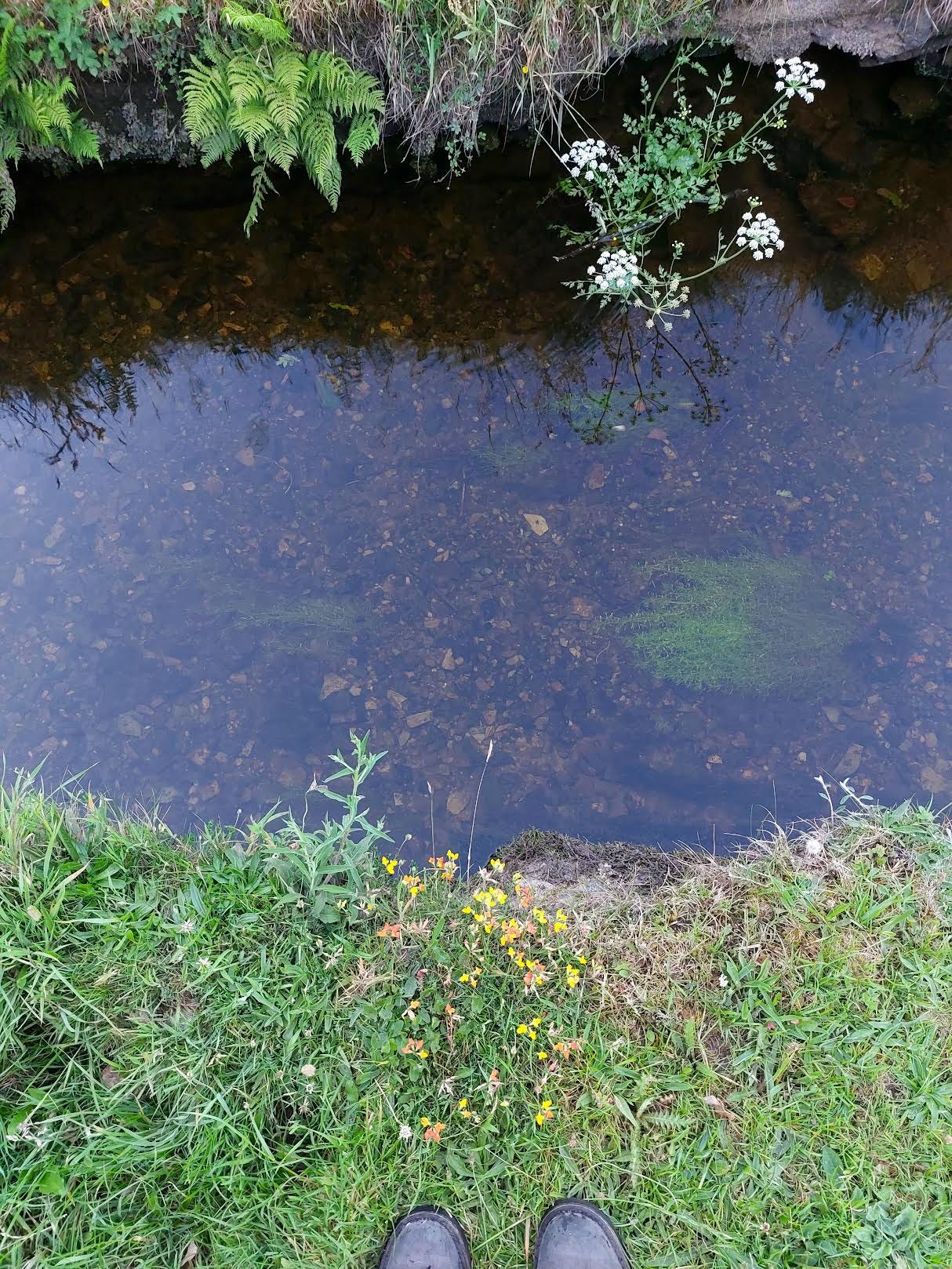
I walked along by the water for maybe ten minutes or so. It was a good path, but it was so continuously level I started to think this waterway ran in parallel to the river, & if I kept walking this path I would never reach the river.5 I doubled back to the main path & followed the riversound down until I saw the light on the water, glinting white through dark branches. Hello river! I went onto the bridge & gazed for a long while— green leaves, silver water, black rocks. The river was overhung by beautiful ancient trees. In fact it was the first wild river I’d seen in England; I fell deeply in love at first sight.6
As I said last time, tracks speak, they tell you where to walk— just follow where the other people have repeatedly walked & you will come to the good or useful thing!7— so I turned off & followed a slightly overgrown side path down through the burgeoning weeds to the river’s edge, then walked along it until I came to a place where the tree roots were bare, elevated from the dirt by much walking-over: a slipway into the river. It seemed like a place where animals drank & humans swam. (Was this the time of night when animals came out? Foxes, badgers— even otters? I had no idea, but it was novel to think about. I knew there were otters in the river, because Michael had said he saw one when he was fishing. He said the otter looked at him like, Come on, mate… You’re so slow at fish-catching!) It felt so good to be out after dark, finding my own way in a brand new landscape. It was the most alone I’d been in months, which made me feel safe.
The riverside rocks were flattish, smoothed by water & deep time. I really wanted to lie down in the river, but it seemed inadvisable. As well as the aforementioned factors (alone in a dark unfamiliar landscape), the rocks were slippery, the river was dark, & I didn’t have a towel. Instead I took off my boots, waded in to the knee & dipped my arms in to the elbow— riversocks, rivergloves— & washed my face. As a stranger in a strange land there’s so much one doesn’t know, but this water felt clean, & it was deliciously cold medicine. Afterwards I dried my feet on the hem of my dress, put my boots back on, then stood on the bridge & watched the bats hunting over the river for a long time, one of the most beautiful things I’ve ever seen.
Then I walked back up the track— it was dark by now, but I could still see & feel my way— washed my face & hands (but not my feet), went to bed, & dreamed about the river. I knew I would. I dreamed (among other dreams) that the river was inside the house, knee-deep, & in the dream I was thinking, just as I had while standing in the real river, I could just lie down in you. It would be so easy.8
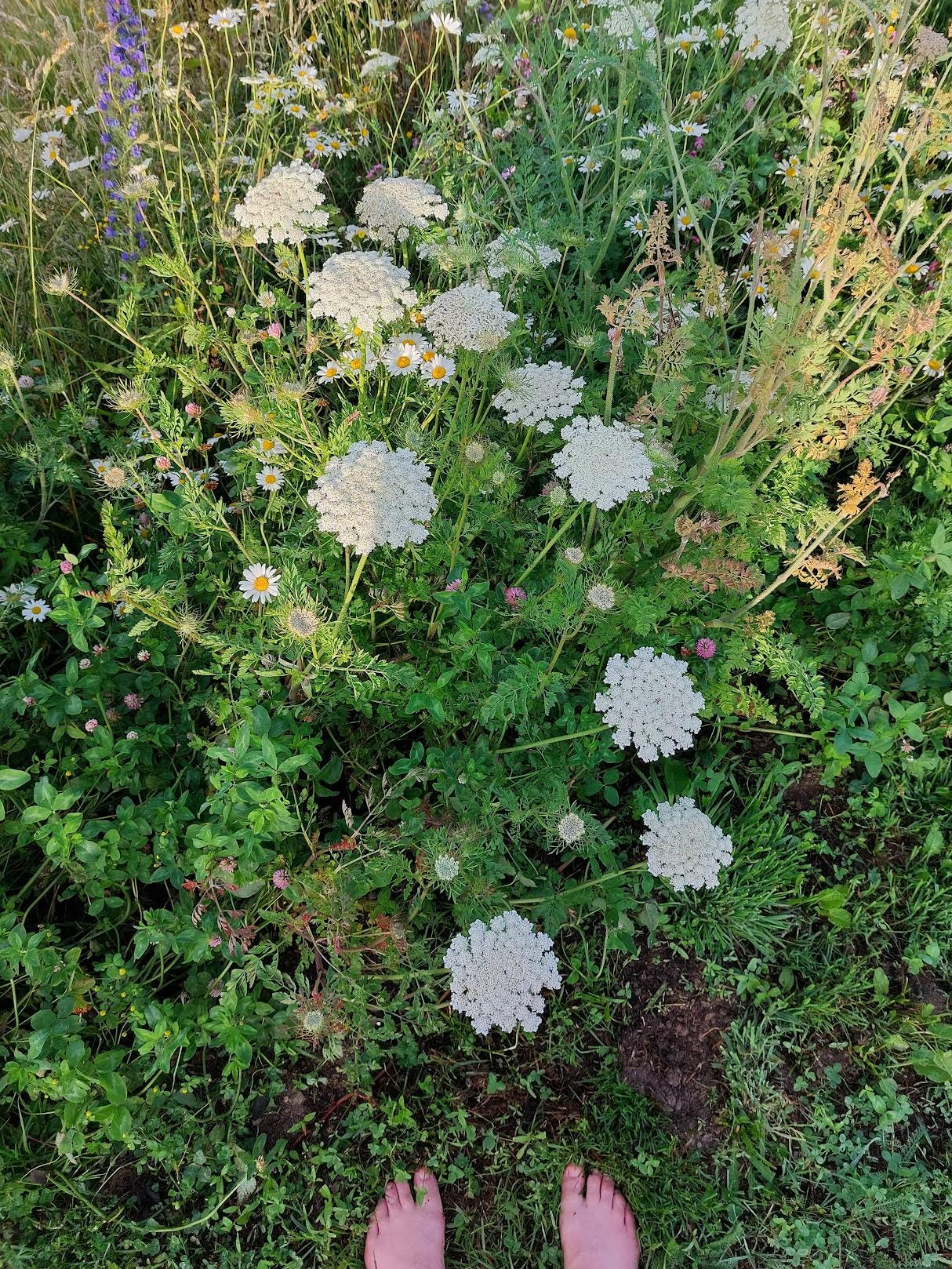
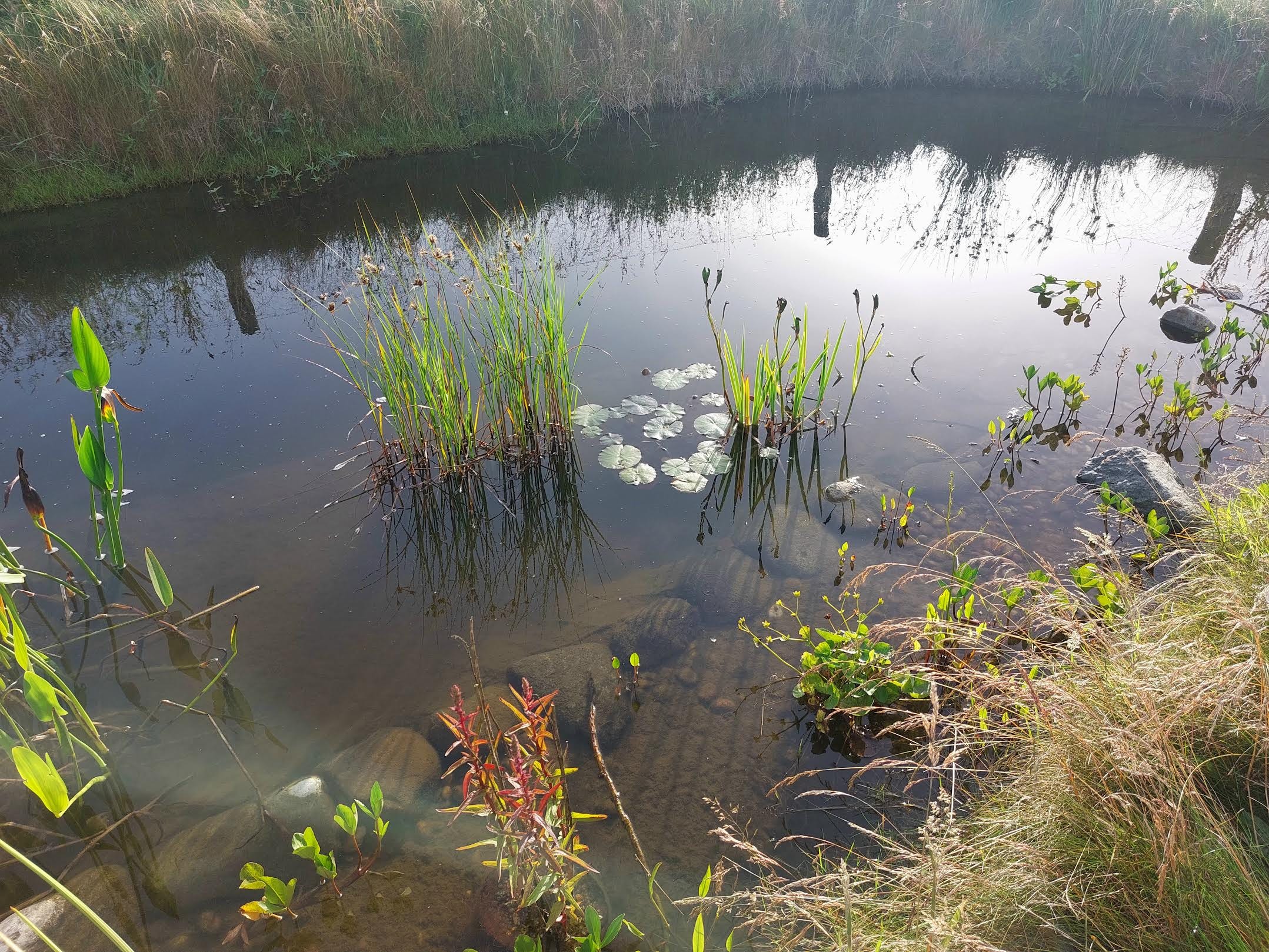
The next morning I got up early & walked through the dewy grass to the pond to see if I could see a newt. I didn’t even know what they looked like, really: were they big? Small? How did they move? I knew there were newts in the pond because Michael had said he’d seen one rising to take a water-beetle from the surface, just like a trout. Also he had seen one when he was underwater in the pond, which gave him the idea to sell a meditation experience to hippies where they sat in the bottom of the pond & newt-gazed. I said if you gave them a breathing tube they could stay down for longer, then Michael said he had an even better idea, they could select & harvest their own reed to breathe through from the side of the pond. Then Caroline Ross said that if she had a reed, she would turn it into a pen. Then we speculated about what baby newts are called— newtpoles? (I looked it up later- they’re called efts.) In any case I didn’t see any newts, nor the golden-eyed toad that had also appeared in my dream.
As the sun rose the temperature rose with it. Later, in class with Caroline Ross, the small village hall was like an oven. I got hotter & hotter. My clothes were saturated in sweat. I couldn’t stop fantasising about lying down in the river. There was no escape from the heat, & nothing I did— drinking water, seeking shade, wetting my hair, fanning myself— seemed to cool me down.9 Before I left Aotearoa I’d flipped a card for the journey: Lust, the Thoth deck version of Strength, which shows a naked golden lady riding a multi-headed beast. It’s a Leo card, which I interpreted as advice to go bravely adventuring in the lion’s mouth, on the back of the beast— ride the Apocalypse, basically. That card was coming back to me now, inside the terrible heat. No more water, but fire next time.
The heatwave was driving me nocturnal— or crepuscular, anyway. That evening at dusk I went down to the river again. This time Jonny followed me down, & we slipped into the dark silky water & swam for half an hour or so, floating, yarning, playing in the waterfalls. (Jonny told me a Northumbrian dialect word for pushing your face into fast-running water, but I can’t remember what it was.) I could tell this was a peak lifetime swim experience. Both my meetings with the river had the quality of dreams: I knew that I was experiencing something precious, a jewel of a moment, that I would return to in memory again & again. (I thought afterwards that maybe this dreamlike quality was partly because I never saw the river by daylight, only in the velvety half-dark.)
We got properly cool in the river, cold to the bones. When I went to bed my belly was as cold as a frog’s— but I woke at 4 a.m. drenched in sweat.10 I tried going into the living room & lying on the couch but it was just as hot in there. It was already light outside— everything was painted in the subtle colours of first light— so I decided to get up & walk rather than lie in the small box of the house. I put my dress & boots on, grabbed my bag & my big bottle of water, & set out. Such a free feeling to open the door & go! Up the hill rather than down, in the direction we hadn’t driven, because I reckoned it would take me to the hilltops. I was soon through the little cluster of stone houses & walking up the road. It was good to be outside. Never a person, never a car, just me & hedges.
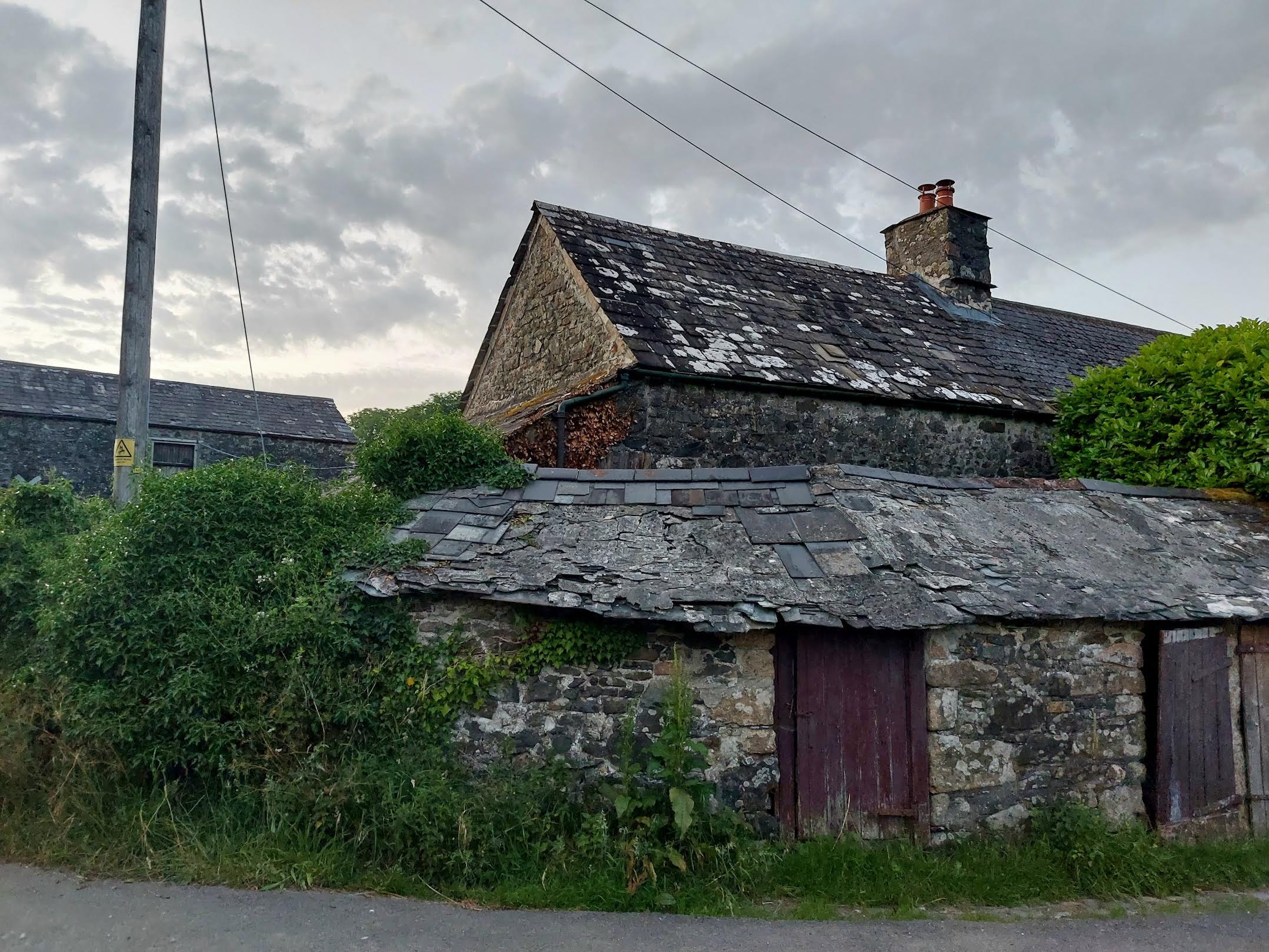
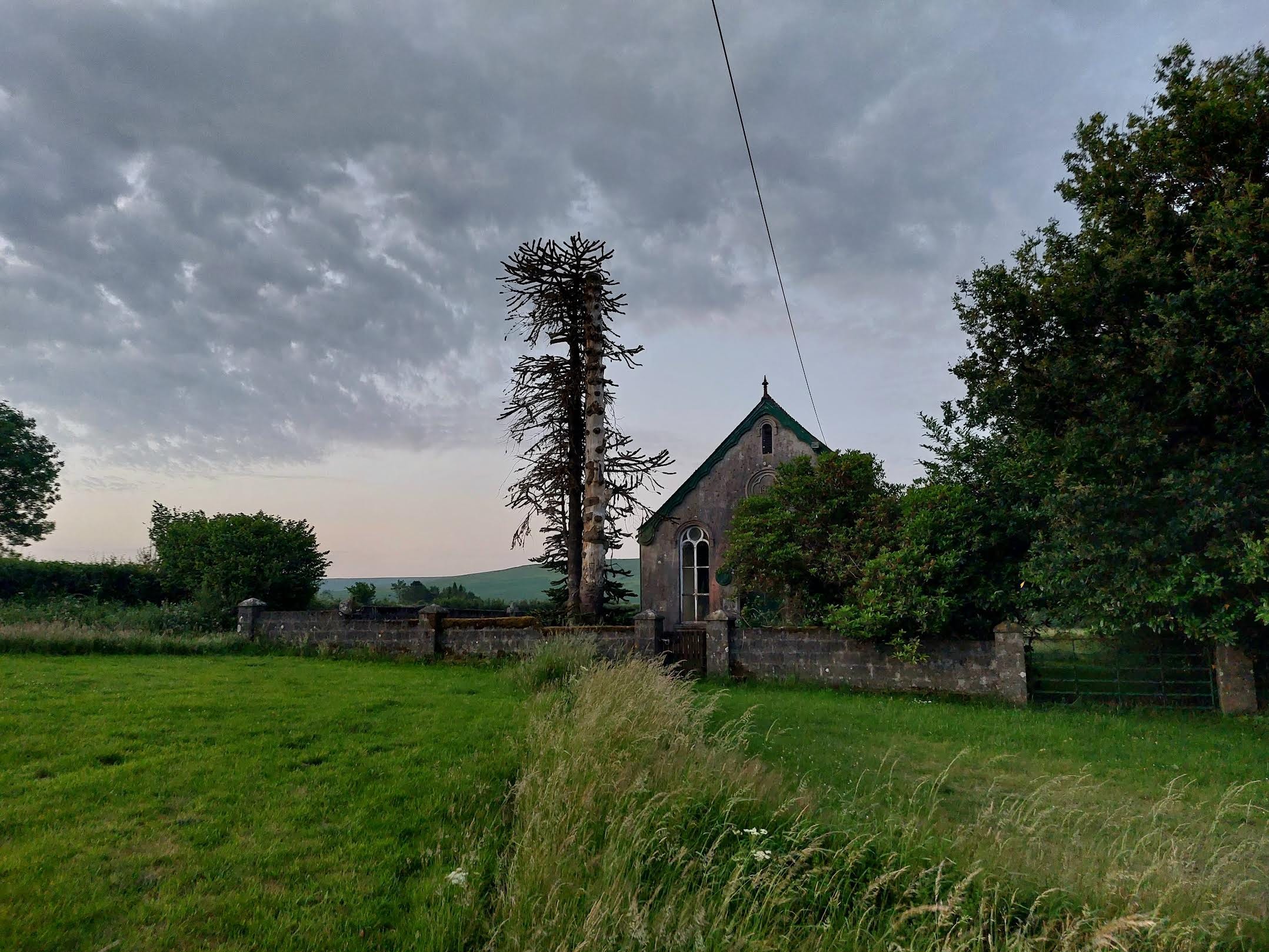
I had a good few hours up my sleeve, & it made absolute sense to be up before the sun in weather like this.11 Back in Aotearoa I often get sleep-deprived at Midsummer because of the long days, but these days were the longest I’d ever experienced, less than a week past English Solstice.12 I hate to go to bed while it’s still light outside— it feels like being a kid— but in England I’ve had to, since I wake up every morning round 5.
The hedges up here were the best I’d seen. There’s a certain look that comes with deep time, a pleasing patina of complexity that can’t be faked. Moss & lichen for instance, or the shapes of trees, or the weathering of rocks. The land itself is like that in England, worked & reworked for a million years. I told Michael (an archaeologist) that I hadn’t been to any prehistoric sites & he pointed to the nearest high hill & said “See those ridges? They’re early Mediaeval lazybeds.”13
I said “Yeah, if I started walking now, I could probably get there by midnight.”
(Reading this I see that to me ‘being’ is not seeing— it’s touching. If I’d gotten to a tor, I’d have kissed its face.)14
Eliza once told me that touring is not really going to places because you’re always travelling, seeing things out the car window. (I had a little taste of that itinerant bard-life when I was kicking around up North with Jennifer Reid.) It’s a real pleasure to be driven, though, & you do see cool things out the window: that’s how I saw these ponies. The ponies are the bosses of Dartmoor, they stand around all over the road. The car was forced to slow down as they ambled out of the way so I tried to catch them out the open window as we passed:
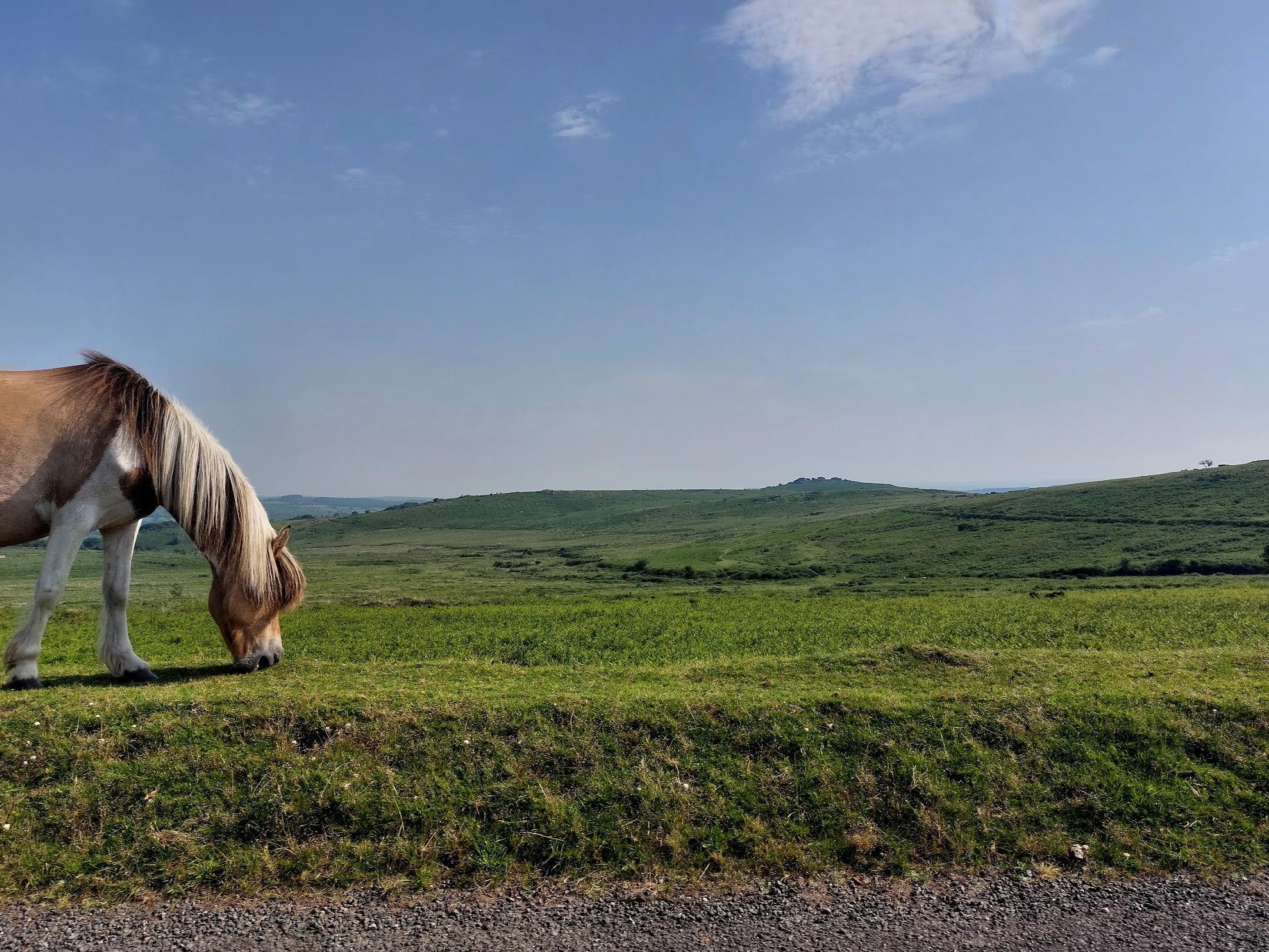
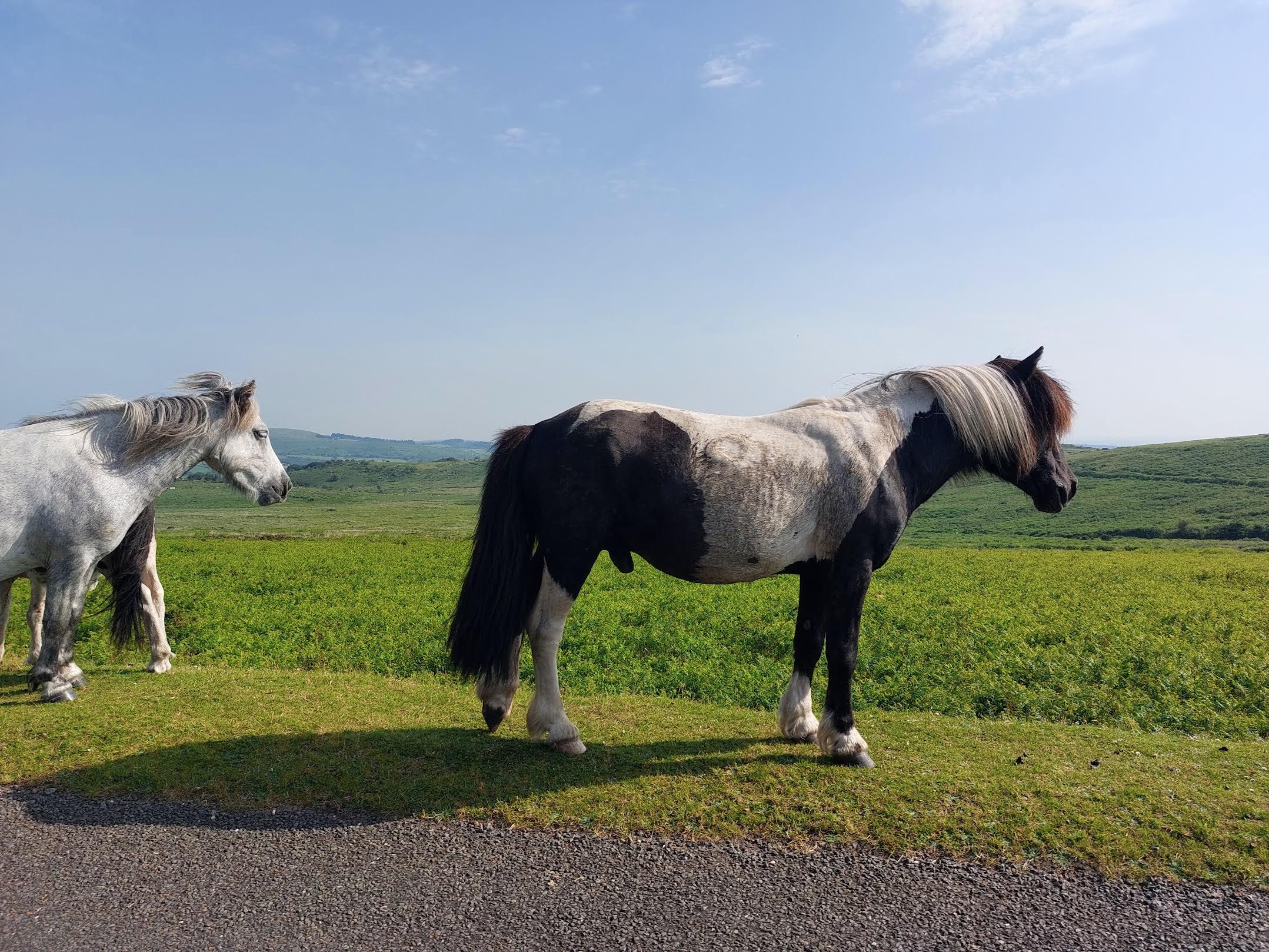
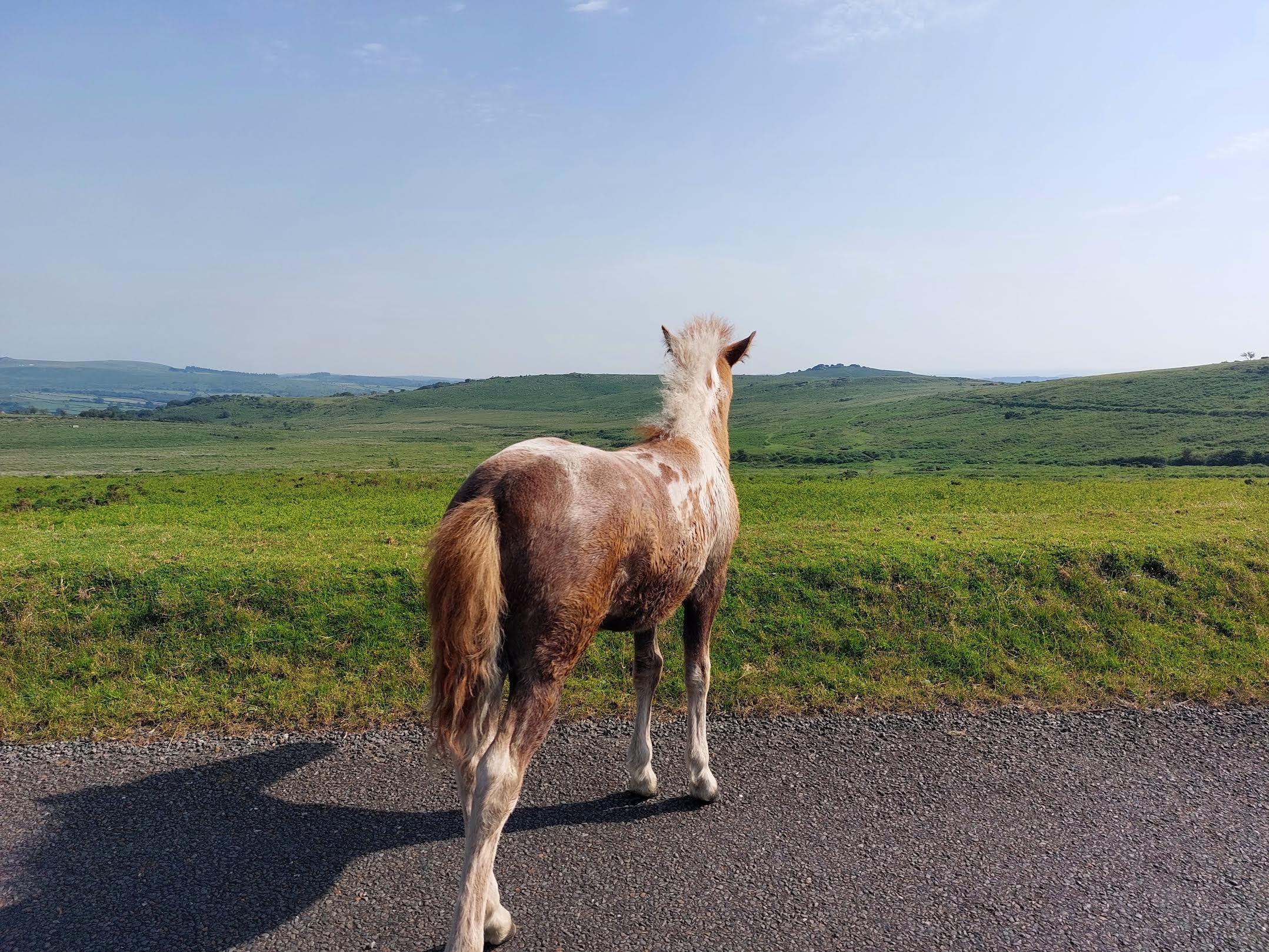
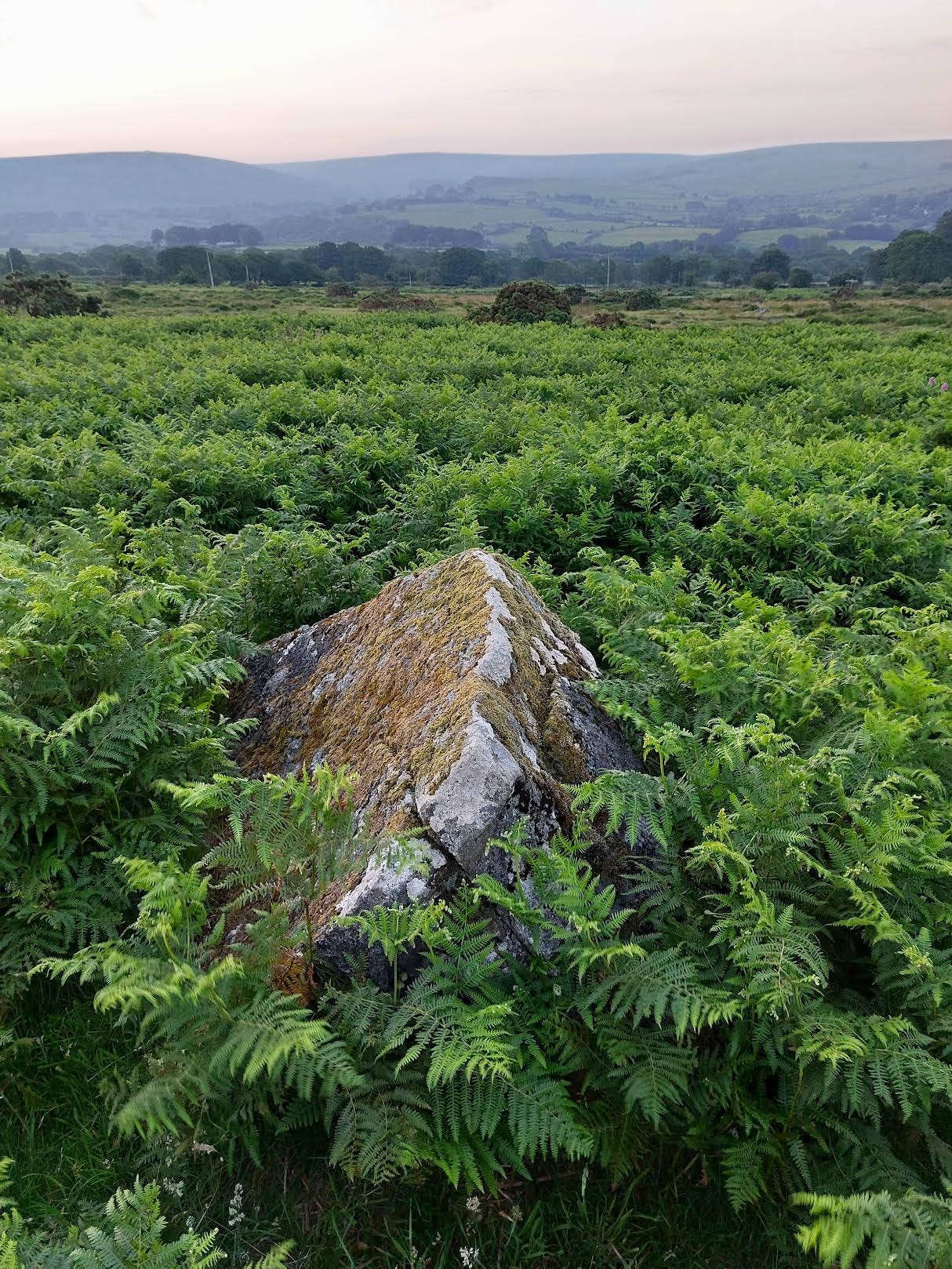
The hills were everywhere, peeping over each other as my vantage point changed, rising like waves. I was climbing roughly along a hill-spine, which made the view lively. I was dawdling, though, taking photos on my camera of everything that took my fancy: flowers in the hedgerows, clouds over the hills, boulders in the bracken.15 A farmer had recently mended the old fences with bright new wood, which stuck out like a sore thumb. I came to the end of the lane & the vista opened up. The grass was studded with boulders, embedded in the ground: had they been pushed up like teeth? Again, I was trying to imagine these rocks deep in snow.
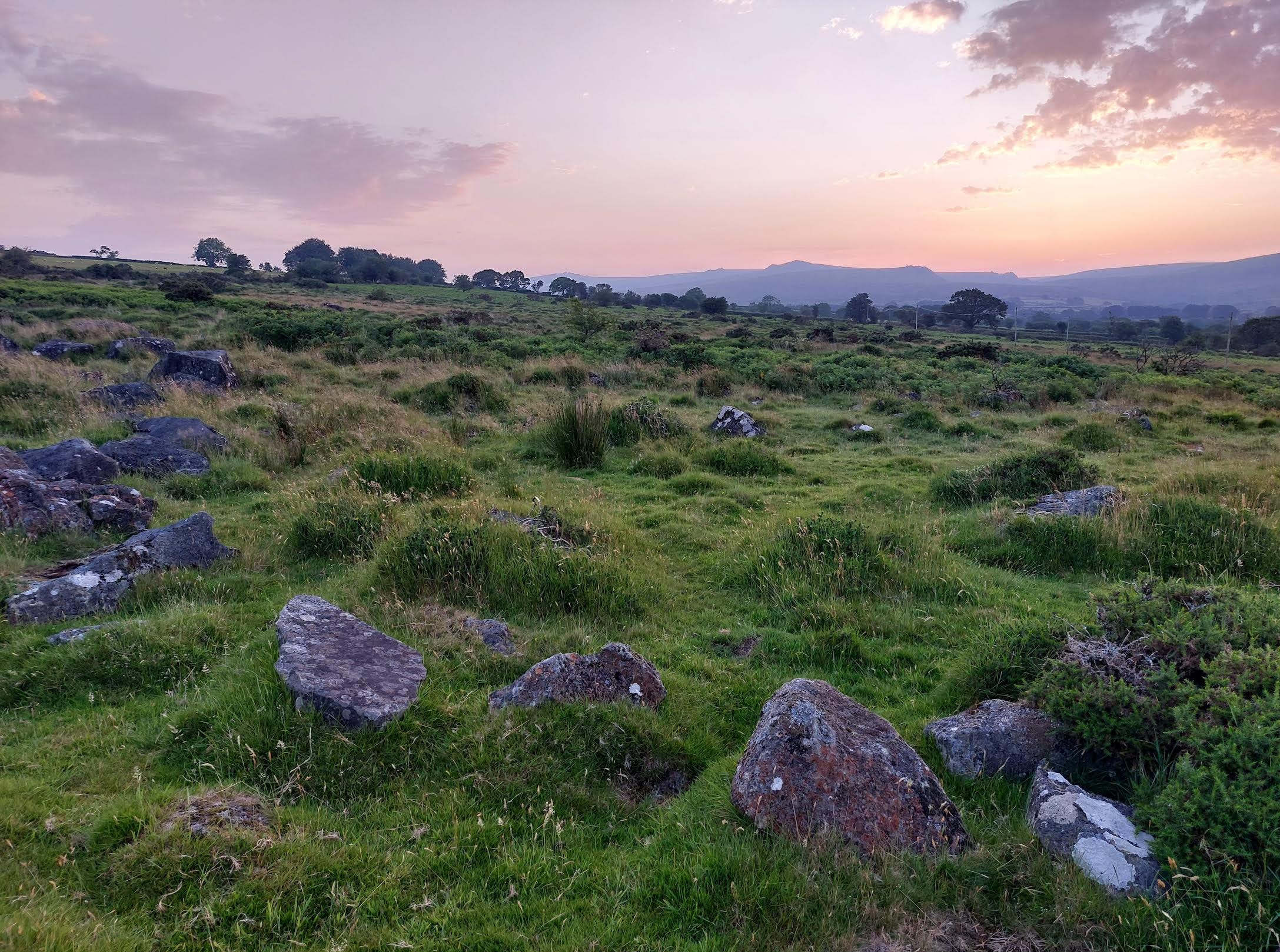
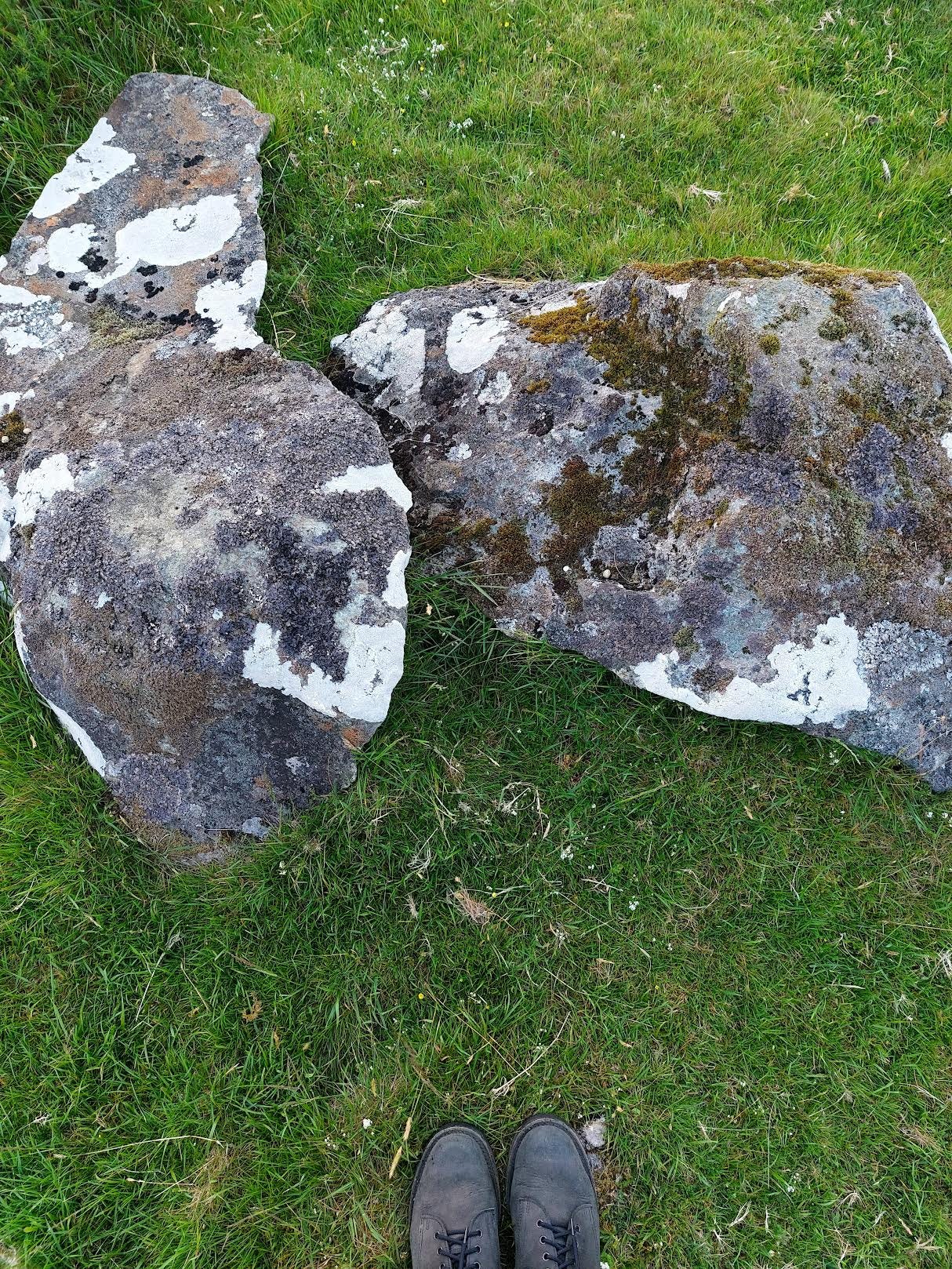
There was a path to the left, through the boulder field, with a sign saying Dartmoor National Park, implying it was a walking track. I could see a building up there at the top of the hill— something industrial & relatively modern. I turned off & started walking towards it, up a road that was like a farmer’s road, wide, dusty, & gravelly. The path adjoined a deep bracken field, & I was thinking about how there were probably adders in there. Kevin Mayes had said that adders liked wasteland, & hiding under ferns. And Michael had told us about the time he got bitten by an adder. He thought it was a bracken scratch but later noticed there were two puncture wounds & his ankle was turning black. He rang up his veterinarian friend who told him adders generally eat mice, so they wouldn’t waste their whole venom load on a human. Michael then went to a party, tripping on the snake venom.
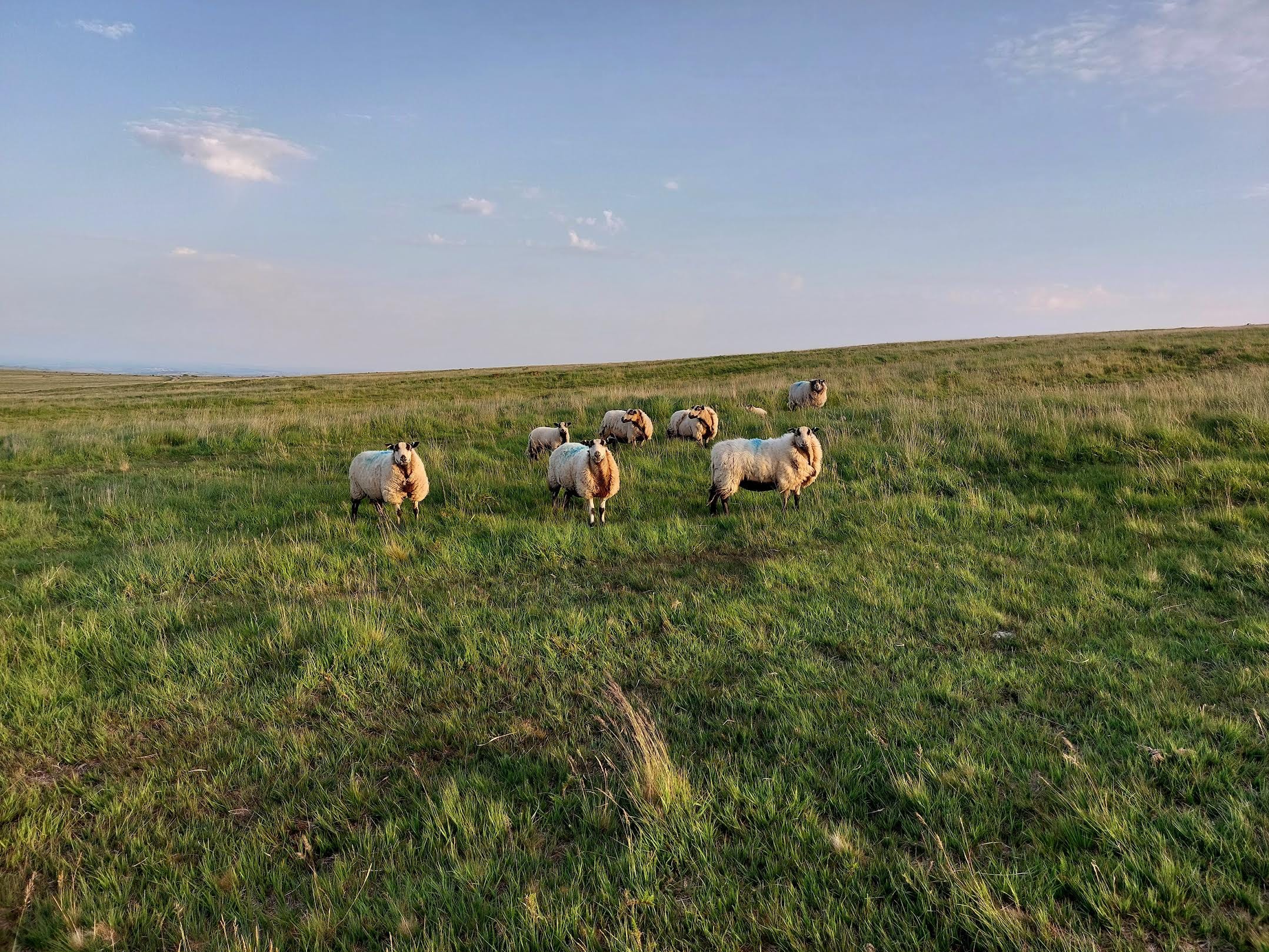
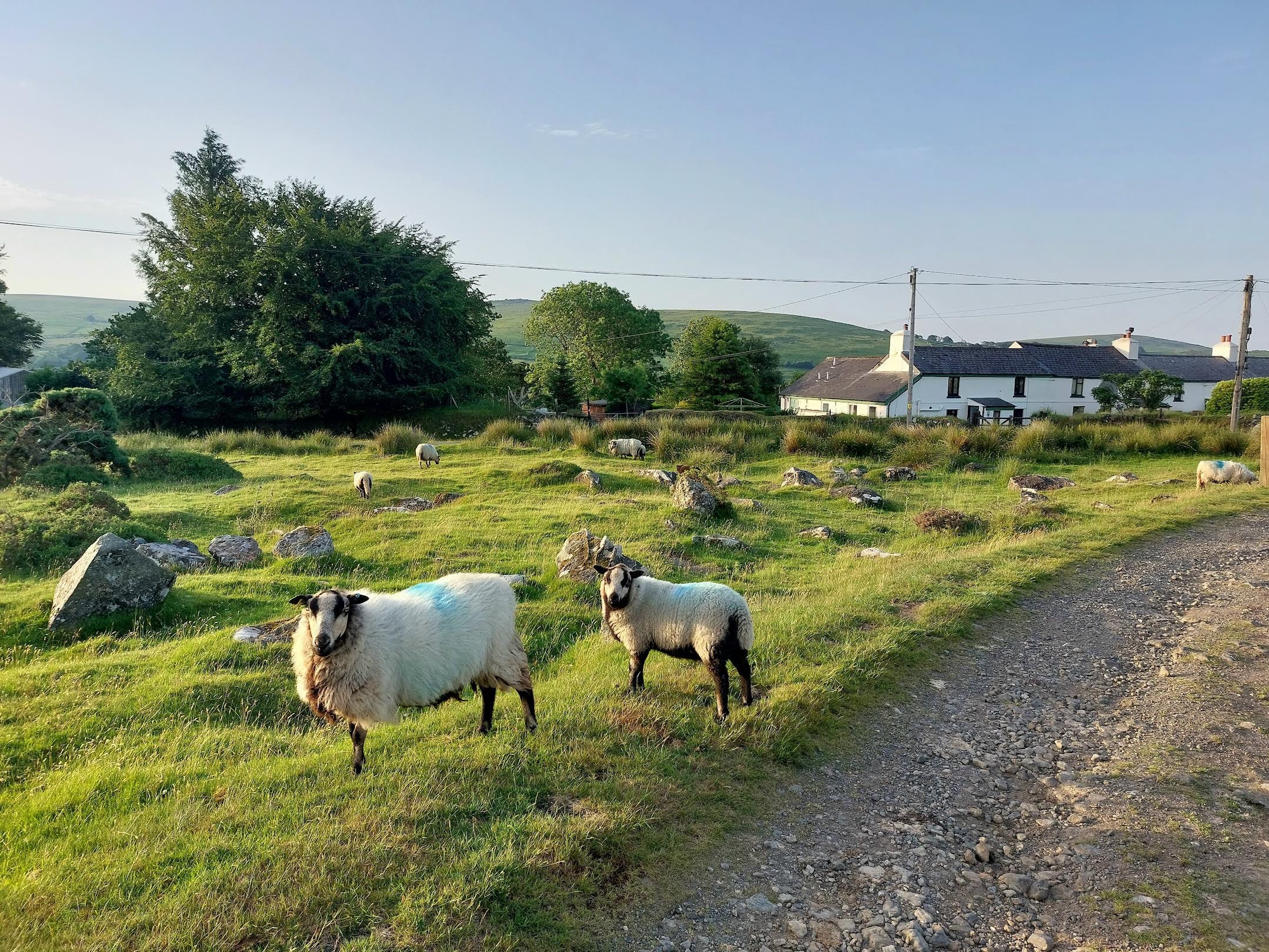
There were tufts of sheepswool on the ground & drifts of it caught like spiderweb in the stones & gorse bushes. Sheepshit, the smell of sheep, the sheep themselves, half-suspicious, shaggy; with black noses, eyes, ears, legs, & bellies, & white backs stained with blue. (I did also see an entirely black lamb: a sport or regression?) When they ran away I saw they still had their tails on. I didn’t particularly want to eat them, but I guess I would if I was hungry enough. The history of England is deeply hefted to the sheep. I was thinking of Andy Goldsworthy’s body of work about sheep & stone. Also the Rosebud in June, one of my favourite songs, all in praise of the sheep: Their flesh it is good, it’s the best of all food, & their wool it will clothe us & keep our backs from the cold.16
I told Kev about the sheep & he said there is a Dartmoor sheep breed, with a curly coat, but that the sheep I saw sounded more like a Hebridean breed or something like that. He said the wool-falling-off thing became fashionable a few years back when the price of wool fell so low that it was uneconomical to shear, so lots of people bought these shedding sheep; but the price of wool has since climbed again, probably because synthetic fibres are made from oil.
The building had steps covered in sheepshit, which I climbed. Behind it was a reservoir: I had seen this on the map, a long thin body of water. It’s easy to see, in a map, what’s been made by humans— straight lines. I was beginning to piece the landscape together. Was this the origin of the small canal? (It was, & I discovered later the small canal was called a ‘leat’.) Michael had told me that the local industry was a copper mine, see that chimney? These houses were miners’ houses. After the mine was worked out the tailings were processed for arsenic, the workers dying young. That reminded me of Ursula Le Guin’s story The Finder (in Tales From Earthsea), in which a tyrannical Mage works slaves to death in quest of mercury. The bucolicness of the sheep-shearing song against the untimely death at the hands of industry: it’s all England.17
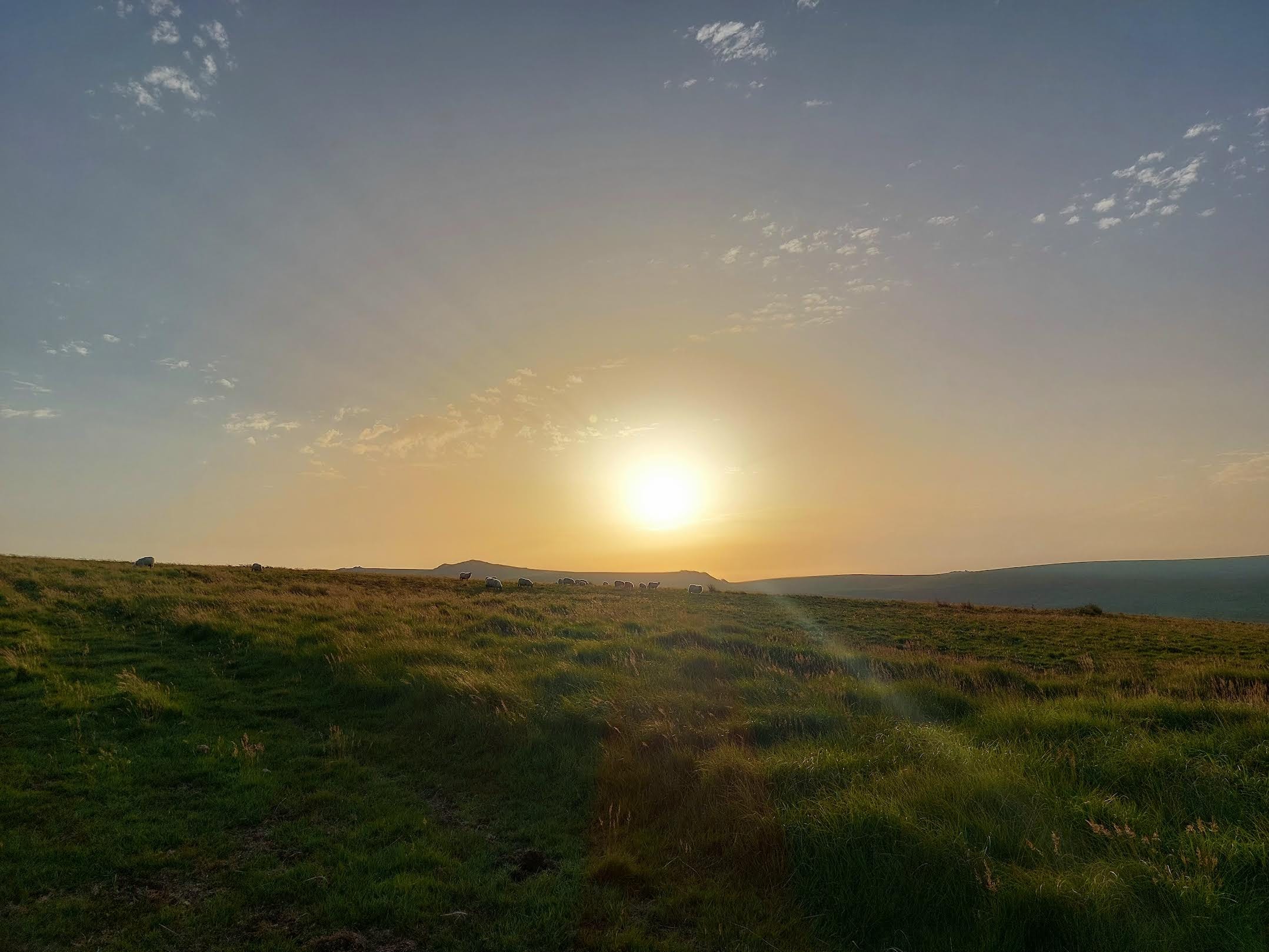
I walked along the reservoir for a while. I hadn’t intended to walk far, & I was beginning to feel hungry, but I did have water, so I decided to push on, to walk to the top of the hill to see the view. (Emptiness is a nice feeling, to a point.) It wasn’t a huge hill, just a smallish one, but there were tracks up it, sheep tracks or human tracks or both, I couldn’t tell. A skylark was singing & the clouds were pink & yellow. As I climbed the hill, changing tracks at will, the sun appeared over the horizon, a blazing eye, a pitiless orb:
Looking up at the crest of the hill I could make out some darker animals, standing like stones. They were Highland cattle, tan & shaggy with big curved horns, & they were right in my way. I tried to read the biggest one’s mood— to see if it had bollocks or not— but I couldn’t tell, so I cut around them to the right. Like when you’re swimming across a river & the far bank seems infinitely to recede, the top of the hill was further than it looked, & I was conscious of time now. As I said, I had been dawdling & wandering on the way up, so I didn’t know exactly how long it would take me to get back down, & I wanted to get back before the others got up so we could eat breakfast together. Caro was teaching in the middle of the days,18 so mornings & evenings were our hangout time, & it was our last morning together.
Then, as I walked along the hilltop, I came across something human-old. It was a pair of waymarkers: tallish stones of rough granite, gilded by the rising sun. The left hand one had worn letters & numbers carved into it— WD? 4.5?— presumably the name of & distance to the next town along. These waystones would be visible even above fairly deep snow. The right hand one— unmarked, unless time had worn the writing clean away— was garlanded with sheepswool around the base. It was easy to imagine living here in the before time, when walking from one town to the next over the tops was the quickest way to take your cheese to market, or whatever your purpose. This was a good turning point, so I turned & started striding back. Now I could see where to go, I could reckon the distances, as a bird flies. Backtracking, yet all direct & all downhill now. At this point I saw the first sign of human life: a red van— maybe a postie— tracking across the next hill. Here’s some sheep, looking noble:19
As I came down the hill, I saw four or five crows take flight.20 This number is unusual, as crows usually go in pairs. A bit further along the path I came upon their smorgasbord: a dead sheep, lying on its side with its legs sticking in the air. There was a puddle of pink froth issuing from its snout &… I didn’t want to look too closely, but its eyes were gone, pecked out by the crows. Just like the idea of wild animals down by the river, this crow-feast felt foreign & strange to me, even though I’ve seen a dead dolphin with its eyes pecked out by seagulls back in Aotearoa. Would a seagull peck out a dead person’s eyes? Probably. But a crow definitely would.21 I thought of the aftermath of a battlefield, the quiet scattered dead, the crows coming in to clean up. Like the heat, crows eating eyes is not personal— but it feels personal. When it comes down to it, we’re just another animal, made of meat.
I passed by the bracken, which I had reckoned to be full of adders:
And the boulder field, with some more sheep. (Almost back at the road now.)
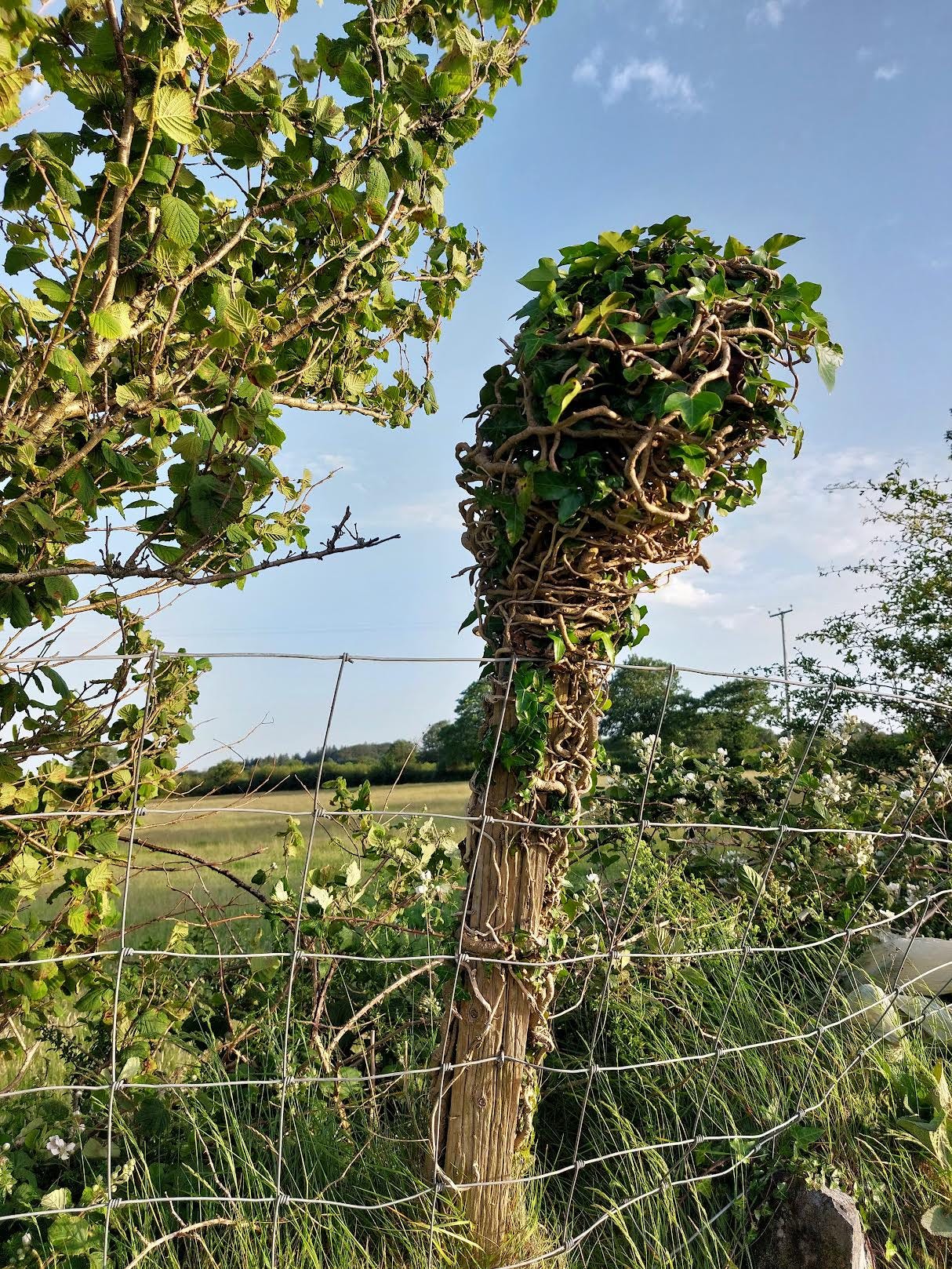
On the lane I saw this wind-sculpted knob of ivy, the tree to the left caressing the ivy intermittently with its leaves, so that I had to wait for my shot:
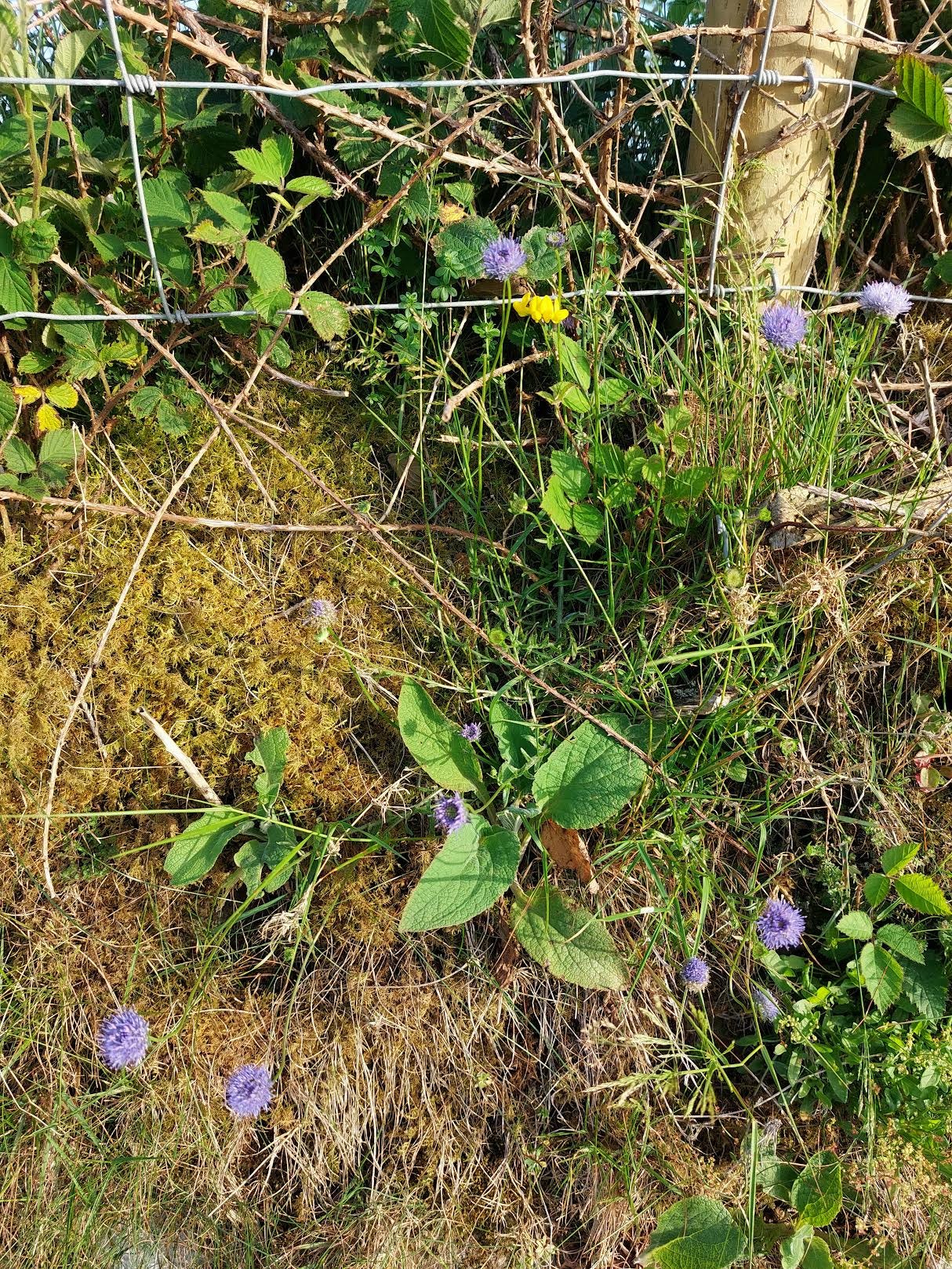
I was empty, light, hot from the sun (early & weak as it was) & the brisk walking, but I was on the home stretch now, not far to go. Mystery flowers:
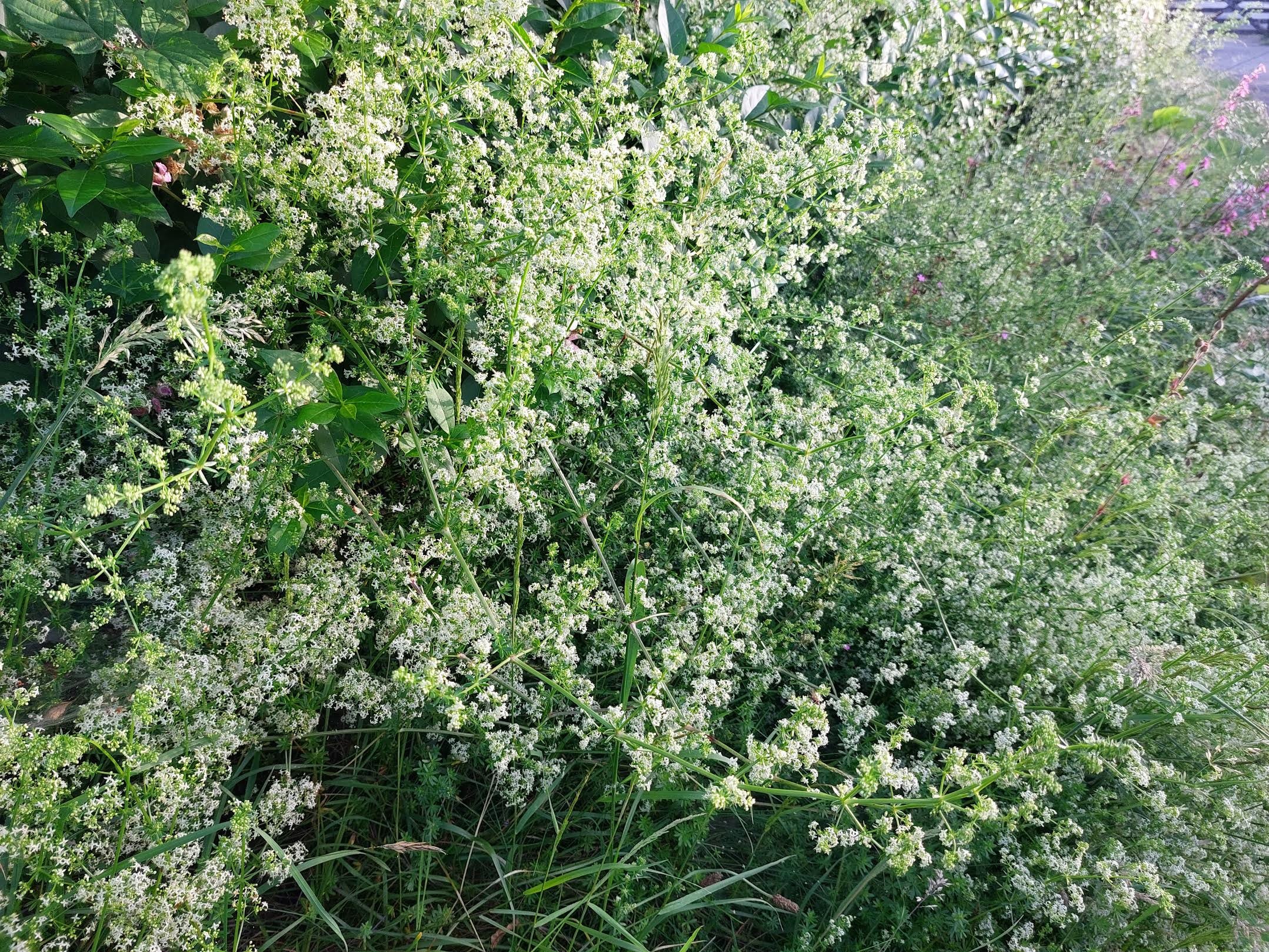
And back into the hedgerows. Banks of weeds & wildflowers. (Are they even weeds here, though? Things mean different things here. Plants & animals in their right place, treasured, when the very same ones in my place are pests, feral, deserving of death.) My nose drew me to these beautiful, delicate, sweet-smelling sprays, which Sarah Crowder reckoned were bedstraw. (She said Caro would know which kind, because you can make a dye out of the roots.)
I made it home in good time. It was almost 7 a.m. When I got in the door the others weren’t up yet, & I sat down at the kitchen table feeling that particular virtuous feeling of having already been up for hours doing things & nobody even knowing about it yet. The other song that had been running through my head up on the moor was The Manchester Rambler by Ewan MacColl:
This song was sparked by seeing a flower with small mauve bells that I thought was heather. He sings, My rucksack has oft been my pillow, the heather has oft been my bed— & while that’s not true of me, it’s still a song I love from the old propagandist.22 It’s clear that for MacColl the mountains are a holy landscape.
Back in London, the Big Smoke where all the rivers (bar the biggest) have been driven underground, I discovered I’d brought a stowaway back with me, a tiny tick on the back of my thigh. (Just an animal, me, just another pumping river of sweet blood.) I had scratched it off before I worked out what it was. It was tiny, about the size of a comma, & didn’t appear to have drunk anything. The next day I found another, on the back of the other thigh. I put peroxide & sticking plasters on the bite sites. I had been warned about the ticks— an important bit of local knowledge— but not until my second day there. Anyway it was too hot to tuck my pants into my socks, or even to wear pants, & nobody else seemed too worried.
I read somewhere once that we Homo sapiens carry two slightly divergent sets of parasites— the ones that always live on us & in us, I mean, eyebrow mites & the like, intestinal flora, our personal ecosystems— because as well as our own set, we are carrying the set of an extinct hominin cousin. (Presumably Neanderthals, since our DNA proves we had sex with them?)
Estonian biologist Jakob von Uexküll also famously used the tick as his thought experiment animal when outlining his theory of Umwelt— roughly, the objectively experienced world of an individual organism, its ‘self-world’.23 That’s all very philosophical, but being made a host (in the parasitic sense) is an upsetting experience. One becomes paranoid: have I found them all? Are there any more? Why am I still so itchy? (Actually, the answer to that last one was mosquito bites. Foreign bloodsuckers activated my immune system, just like the novel pollen. Alert! Alert! Alien invasion! Barbarians at the gates!)24
Thinking back over my journeyings, I realise they have taken me to every cardinal edge of England. North to Cumbria with Jennifer Reid; South to Brighton & Hove for Leo’s birthday; East to Faversham with Elise Oursa; & now West to Dartmoor with Caroline Ross. An upside-down cross, with the filthy jewel of London at the centre. (Reading this pattern… my friends, like me, are edge-dwellers.)
This time round I’ve felt both limitation & freedom. Limitation of time, mostly (which is also money)— but I’ve had the freedom to get as far as I can under my own steam, to trust in gift & sense & to follow my nose & the open paths.
Why did Dartmoor feel so amazing to me? The wabi-sabi of the close-up forms— the bonsai’d trees, the smoothed rocks. The long views into the misty distance (fairy-taleish: shades of The Hobbit). The tors scattered throughout the landscape: these rock formations had a powerful aura, being set so high, & also a strong magnetism— I had a desire to climb to them & see them up close. The river— the bats— the invisible newts— the ponies— ponies! Little wild horses! Fundamentally though, Dartmoor was the first place in England I’d been properly alone. In my evening river-walk & in my morning hill-climb I saw not a single soul. Solitude & stretchy time are my Wizarding state, because I can wander at will, uncompromising, unobserved. This allowed me to speak directly to the land, & it said
Once I wore a garment
A cloak of thick forest
Woolly rhino & mammoth grazed me
Wolf & lynx
Stone axe came
Now I’m skin & bones
Skylark & sheep
You walk my nakedness & call it beautiful
Yes
I am stone dancing with fire
The dance we have danced since time began
We have borne uncountable children
I have worn more skins than you can imagine
Seasons flicker
Little mayfly
Everything is food for everything
Maddy Maine: “Doesn’t the ‘wave’ refer to the shape of the temperature on a graph? That’s very ocean-hemisphere of you, to think of the sea.”
Me: “Very good theory, I had not thought of that.”
I keep thinking about that Kim Stanley Robinson novel I once half-read, before getting too scared & having to stop.
Me: “I’m just trying to describe the heat.”
Maddy: “Inescapable… claustrophobic… sense of impending death.”
It was a DMU, a Diesel Multiple Unit, i.e. each carriage has its own engine underneath, making riding in it a delightfully noisy experience. The seats & floor were scattered with leaves & as we went along I realised this was because the open windows of the train (& because there was no aircon they were all open, but it made no difference to the heat) were catching the leaves of overhanging trees & biting them off, flick, flick, which made me think of a hungry dinosaur.
Jonny told me Devon is famous for its high hedges. He said once he went on a long bike ride that was pretty much hedges all the way.
This turned out not to be true. Apparently if you walk far enough a side path turns off the canal path down to a particularly good swimming hole, & looking at the map, I can see it does eventually join the river. But I also needed to find my way back afterwards, so I decided to stick to the more obvious / navigable paths.
“He thought his happiness was complete when, as he meandered aimlessly along, suddenly he stood by the edge of a full-fed river. Never in his life had he seen a river before—this sleek, sinuous, full-bodied animal, chasing and chuckling, gripping things with a gurgle and leaving them with a laugh, to fling itself on fresh playmates that shook themselves free, and were caught and held again. All was a-shake and a-shiver—glints and gleams and sparkles, rustle and swirl, chatter and bubble. The Mole was bewitched, entranced, fascinated. By the side of the river he trotted as one trots, when very small, by the side of a man who holds one spellbound by exciting stories…”
Kenneth Grahame, The Wind in the Willows
This book has a lot to answer for when it comes to instilling a romantic view of England into small colonial children, it’s so unabashedly laudatory of English nature that it’s almost propaganda. For instance I have been thinking a lot about this excerpt: “The pageant of the river bank had marched steadily along, unfolding itself in scene-pictures that succeeded each other in stately procession. Purple loosestrife arrived early, shaking luxuriant tangled locks along the edge of the mirror whence its own face laughed back at it. Willow-herb, tender and wistful, like a pink sunset cloud, was not slow to follow. Comfrey, the purple hand-in-hand with the white, crept forth to take its place in the line; and at last one morning the diffident and delaying dog-rose stepped delicately on the stage, and one knew, as if string-music had announced it in stately chords that strayed into a gavotte, that June at last was here. One member of the company was still awaited; the shepherd-boy for the nymphs to woo, the knight for whom the ladies waited at the window, the prince that was to kiss the sleeping summer back to life and love. But when meadow-sweet, debonair and odorous in amber jerkin, moved graciously to his place in the group, then the play was ready to begin.”
That passage, like much English nature writing, assumes first-hand knowledge of the plants described. It’s not that I think one shouldn’t write that way, but I’m very familiar— as an outside reader— with the feeling of I don’t know what the fuck you’re talking about.
I wrote a bit about the eloquence of paths last time:
Hungover Hedge-Wizarding in Kent

A Kiwi, a Spaniard, an Alabaman, & an Irishman walk into a wine bar. Time passes. The Kiwi says to the Italian proprietor, “Hey, Fabio— do you realise none of us here are English?”
Water in the house is usually an anxiety-dream motif for me, but in this case it felt benign, even joyful
I’d read this piece by Mike Sowden just before I left London, which scared me into drinking lots of water. It’s crazy though how you can drink & drink & still be parched.

When it doesn’t go below 20° overnight, that’s ‘Tropical night heat’, which makes it hard to sleep.
I’m writing at 4.30 a.m. right now, because again, that’s when I woke up. Back in London it’s raining outside & blessedly cool for the first time in a week.
I moved into my new house on the Summer Solstice, which you can read about here:
The Most Beautiful Shrimp

Watching the sunset the day after Solstice & drinking mead from the bottle, wishing that the next year be sweeter than the last; it tastes of liquid honey more than of booze. This is my brand new view, only a few days old, sheen of novelty, every day full of information, & I’m thinking the Sun is as far Southward now as it’s going to go, at the weightless end of its yearly swing...
Michael says “5th - 10th century— essentially Anglo-Saxon period from end of Romans to Norman invasion.”
I wrote about lazybed gardening here: Ask the Farmer! Roadkill & Planter Boxes
This prehistoric-less state was remedied yesterday by Sarah Crowder, who took me up Holmebury Hill, which was covered in flint flakes, the detritus of flint-working— a dream come true for this finder. I also found a jay feather
Sarah Crowder says “The only rule of treasure-finders club: you must promise to dawdle.”
I got this song from my friends, the amazing five-part harmony group Supersheep.
Michael says “The little canal is called a leat, Dartmoor is full of them. This one was built in the early 19th century to take water from the [River] to power large water wheels, used at the mines for pumping water out of & air into the mine shafts. In the 50s, after the mine had closed, the leats were used to power a hydroelectric power station.”

Boy? Silver?
The Manchester Rambler was one of MacColl’s earliest songs, written in the early 1930s following the Kinder Scout Trespass in 1932.
If you want a MacColl primer, this tribute album is (mostly) great:
Joy of Living - a Tribute to Ewan MacColl
A tick’s umwelt is simple: light (to climb to the top of a grass); butyric acid (to detect the presence of a mammal); & heat (to know where to suck). Apparently a tick can sit & wait many years for a warm-blood to pass by
How did Martin Shaw avoid getting peppered with ticks during his long vigils in the Dartmoor wilderness? Maybe, as a native, he’s immune.
Reading from the States...lovely words and photos. We have something of a heatwave here ourselves and even the nights aren't properly cooling down....I think your instincts are spot on. Find the creek. Meditate on the frogs!
I keep wondering what the heat index was during all this. Temperatures around 40 aren't uncommon where I am in the summer, but typically the humidity drops way down as the day progresses. That kind of landscape holds a lot of water so it would be muggy, I'd think, and quite dangerous.