

Universal Basic Income Dreaming
'That which does incourage us in this work is this; we find the streaming out of Love in our hearts towards all; to enemies as well as friends; we would have none live in Beggery, Poverty, or Sorrow.'

“In Magie’s original version of the Landlord’s Game, players earned money by completing a circuit round the board and passing the square labeled Labor upon Mother Earth Produces Wages, which is now simply Go.”1
“Free your mind of the idea of deserving, the idea of earning, and you will begin to be able to think.”2
Phở
Yesterday I met Dan Keane for Vietnamese. Our opening conversation: ‘What are you writing about?’ Dan said he was writing about kapa haka. I said I was writing about Universal Basic Income. “The thing is,” I said, “The arguments against it are mostly not logical, they’re ideological; actually, they’re emotional rather than economical.”
Then we ate our phở.
Éire
It all started a week or so back when I came across this fascinating scrap of info on Notes, shared by genial Yorkshireman-about-town Mike Sowden:
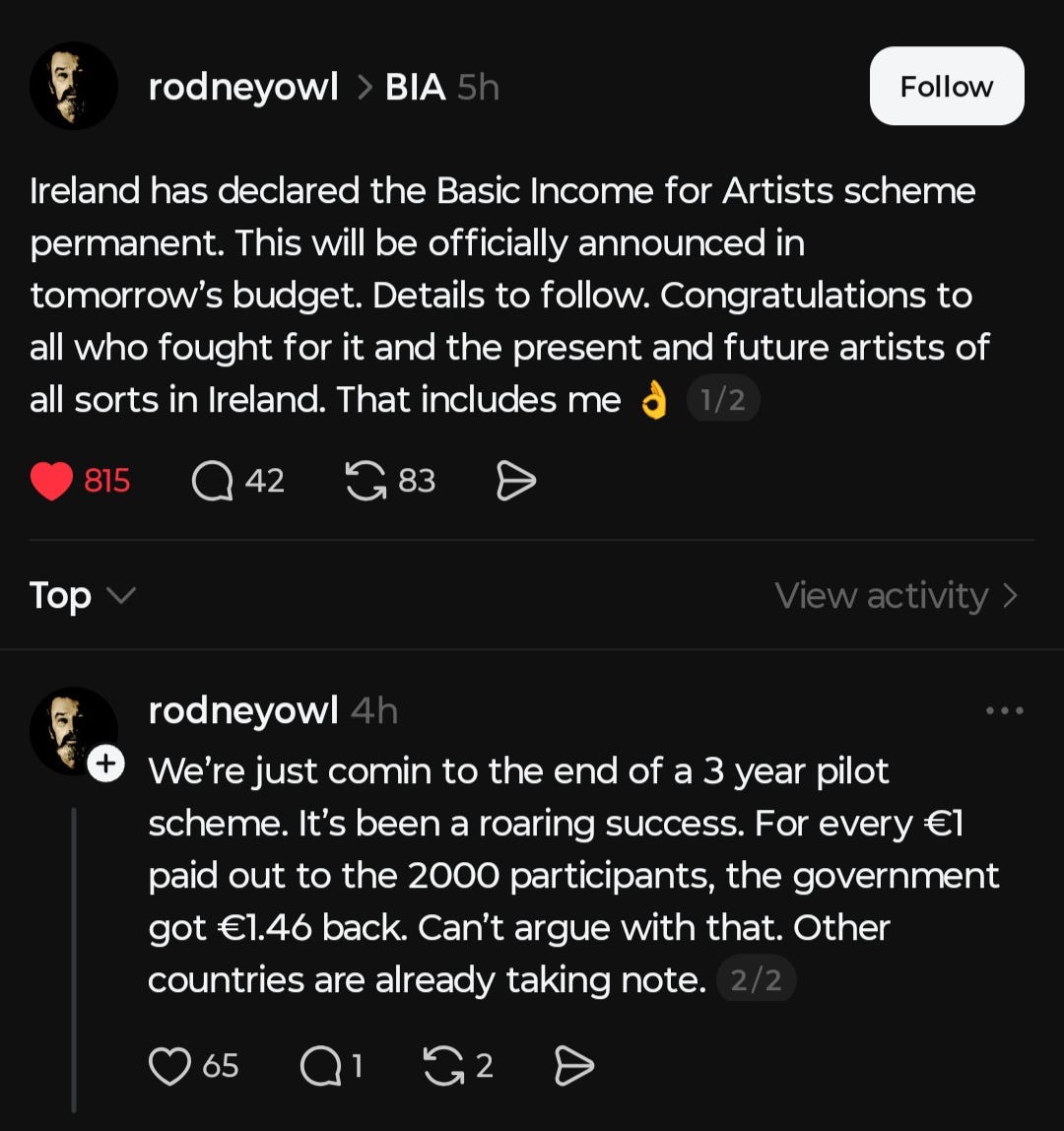
Upon investigation, it seemed legit,3 so I banged out this Note of my own:4
Ireland have been trialling UBI for artists for three years & have just decided to make the scheme permanent, because (surprise surprise), IT WORKED! Not just for the individual artists, either— there was a return on investment to the tune of almost 50%.
[…actually just a ‘BI’ as a few people have pointed out— not ‘Universal’.]
‘The main objective of the scheme is to address the financial instability faced by many working in the arts.’ (Looking into it I discovered they have also been running a similar scheme for farmers.)5
A more general UBI has also recently been trialled in Germany with similar results. The inability of most governments to show any imagination or willingness in this area is mostly due to ideological fixity rather than, you know, actual logic. The arts sector in New Zealand has been pretty much scuttled over the last few years, &— erosion of cultural goodness aside— that’s actually shit for our economy, not to mention our international standing.
Tip of the Wizard hat to Claire Mabey, who wrote about this in the Spinoff yesterday: “I’m really sick of art being seen as an indulgence. It’s been proven that that attitude is bullshit across all measures: for daily life, art is as necessary as fruit, veg and exercise; for the GDP, have a go at counting to 17.5 billion.”
A Supplementary Rant
A few days later, after lots of people shared my Note (many in joy, some in order to diss it), I added the following rant onto the end:
Update: I posted this after looking into the scheme a bit, & reused the image Mike shared re. ROI. I didn’t personally parse the figures because I couldn’t find them, so I can’t defend that bit.6 However, the benefits of art to the economy AS WELL AS TO SOCIETY AT LARGE are nevertheless real. THE LITERAL ENTIRE POINT of this scheme was to bridge the financial gaps that make art a precarious career path. That’s one reason why artists are a logical place to start with a scheme like this. (Hmm, but remember how I mentioned the farmers? Is farming also frippery?)
I am not deluded, I don’t think all the governments of the world are going to introduce UBI tomorrow. The point is that UBI is actually a viable answer despite the difficulties of implementation, etc. Like I said, it is not LOGIC that stands in the way, but ideology.
In real life the economy runs healthy when money moves around at the bottom end, the more transactions the better; the economy stagnates when the rich suction money out of circulation. That is what stimulus means. Poor artists (& other people who spend instead of hoard, such as farmers) getting money stimulates the economy; billionaires hoarding & exporting money (i.e. removing it from circulation) depresses the economy. This is why money has to be taken out at the top end & redistributed at the bottom end. A dead economy serves nobody— ultimately it doesn’t even serve the 1% when society breaks down.
Lastly, to the people who think artists are scum— firstly, like, what are you doing here? Secondly, I guess you don’t listen to music, then? Or watch movies? Or read books? Or like, consume the work of artists in any way? Oh, you DO? Where do you think that stuff comes from? People make it, my dudes. /end rant
Old People’s UBI
In Aotearoa we already have a Basic Income study of our own to consider, though it’s not usually framed as such— it’s called the pension. The next day I added this Note:7
Another thing I think about fairly often: in NZ we have what I call ‘the old people’s UBI’, that is, the pension— universal for everyone over 65. (By the way, superannuation adds up to the biggest component of government welfare spending, at 52% of the total welfare budget.) I have watched many friends & relations turn 65 & start receiving the pension. For those accustomed to sizeable incomes I’m sure it seems a paltry amount, but for a lot of my friends it’s literally a life-changing thing to suddenly receive enough money to live on, no questions asked. I am all for it.
Nuts & Bolts I: Irish & German Basic Income Study Outcomes
A few days after writing the aforementioned Notes I found a news report on the Irish study. Art News - Three Years After Trial Launch, Ireland Is Making Basic Income for Artists Program Permanent. It outlines the scheme in more detail, explaining that the BIA trial “was launched to support the arts sector following the pandemic. Many artists suffered disproportionate income losses during that time due to the cancelation of live performances and events.”
In order to qualify, you had to prove you were a professional artist. “For the pilot, applicants could apply under visual arts, theater, literature, music, dance, opera, film, circuses, and architecture. They were required to submit two pieces of evidence proving that they were professional cultural workers, such as proof of income from art sales, membership in a professional body, or reviews.8 At the time, the New York Times reported that more than 9,000 people applied, with 8,200 deemed eligible and 2,000 randomly selected to receive payments. Another 1,000 eligible applicants were placed in a control group to be monitored but not receive funds.”9
As well as the Irish study, I have been following a recently concluded BI study in Germany. This study was not targeted at any particular group, but given to randomly selected participants.
Deutsche Welle: “One of the key findings of the three-year experiment is that people who received the basic income kept working an average of 40 hours a week, dispelling the myth that basic income would make people lazy.
However, a significantly higher percentage of the participants in the basic income group changed jobs compared to the control group. Knowing they had a financial backup plan presumably helped them make the move.
It was also found that more people in the basic income group started studying, sometimes on top of their job.”
(From this article: Free money: Germany’s basic income experiment.
As a more long-term complement to these short-term studies: for over 40 years in Alaska an annual dividend of between $1000 & $2000 per year has been paid out of oil revenue to every man, woman, & child in the State. This little film by the Financial Times looks at the idea of UBI in general, & interviews some Alaskans about how they spend their (& their children’s) dividends:
Money-Go-Round
(CONTENT WARNING: ECONOMICS AHEAD. Mate, talk about a big tangled ball of string…)
The inference by certain commentators that I was a soft-headed woo-woo who didn’t understand the real world prompted me to thresh out my economics some more.10 It’s actually not that complicated: basically, applying stimulus at the bottom end of the economy keeps everything moving. (This is why, during Covid, Labour Finance Minister Grant Robertson applied stimulus at the bottom & in the middle, which worked— it kept our economy afloat in a time of crisis. However, they failed to take it out again at the top end— of which more in a minute.) Applied at the bottom, the money moves around a lot, in the form of many small transactions. It slowly works its way up, benefiting many along the way (& by the way, tax is paid on each transaction in the form of GST— a type of tax that affects the poor far more than it affects the rich, who can afford to save rather than spend.)11 This principle also applies to other money that enters the economy at the bottom end— benefits, wages, etc.
Kevin Mayes explains: “If money is applied at the bottom, where it attracts income tax, much of it moves up into small to medium business (generating GST along the way) and then back down again as wages, where the income tax / GST cycle is repeated. Some moves sideways as purchases from other businesses. At every stage, some is recycled to the bottom, but as it rises through the wealth profile, an increasingly higher proportion is used to buy financial assets that don’t attract GST & only rarely result in new productive investment— the majority being used to bid-up the price of existing financial assets.”
Therefore— & this bit is centrally important— it is necessary to take money out of the economy again at the top end. If stimulus money is sucked straight up, it is effectively removed from circulation: locked up in assets, put into trusts, used for rent-farming & money-farming, taken offshore etc.— that is, hoarded by the rich for their own benefit. Kev: “An economist would say that when money reaches the investor class, it is used to bid up the price of assets.” That is, once the money has been removed from the ‘real world’ of exchange of goods & services (no more GST), it has also been effectively removed from the realm of government control. This is why there need to be counterbalances at the top end (most commonly Top-Rate Income Tax / Wealth Tax / Capital Gains Tax), to prevent excessive profiteering from distorting the economy (e.g. what we are seeing now under the stewardship of a prosperity-Gospel, ex-CEO, multi-millionaire landlord Prime Minister.) Without effective countermeasures, any stimulus applied to the bottom end will be sucked upward to the top end in the form of rent, profit, interest etc., AKA Vacuum-Up Theory (a thing I invented as an antidote to the bullshit idea of Trickle-Down Theory).
It’s a misunderstanding to think a UBI would be paid directly out of tax. Governments spend. They also recoup. It’s important to understand that those two processes are not one & the same: the State doesn’t ‘spend tax dollars’. But when people critique the feasibility of UBI, this top-end extraction is the bit they think would be impossible to implement. The billionaires won’t let us, basically. See also: the whole of society would have to change. Yes, that’s the point: it would have to, & it does have to. You can argue on whether that’s possible, but you can’t argue that a UBI wouldn’t work, because there is ample proof that it would work.
It also depends on what you mean by ‘would work’. Universal Basic Income theory is not only about it works for the individual— though it does that too— so much as it works to keep the economy (& thus civil society) functioning, as a structured countermeasure to the increased parasitism of Capital upon Labour that historically happens when new technology is recklessly introduced, like now. These days the brave new world of tech advancement is no longer even being gift-wrapped in Utopian propaganda— it’s down the robot mines with you, sunshine.
(See also: factory-isation / Luddites. As Brian Merchant points out in Blood in the Machine, the formulation ‘robots are coming for your jobs’ obfuscates the true drivers of extractive automation. “These executives and managers may feel as if they have no choice, with shareholders and boards and bosses of their own to answer to, and a system that incentivizes the making of these decisions— but they are exactly that: decisions, made by people. Pretending otherwise, that robots are inevitable, is technological determinism and leads to a dearth in critical thinking about when and how automation is best implemented.”)
The fundamental point is that the social contract has already been betrayed. The crash has already happened: the ‘Global Financial Crisis’ of 2008. If you’ve forgotten, private banks were bailed out by central / government banks— so who’s taking whose handouts here? (See also: business-owners happy to take a ‘socialist’ Government handout during Covid.) We’re frogs in a pot that’s been simmering for decades. Well, some of us are frogs, some of us are stokers. The barely reanimated corpse of Neoliberal business-as-usual is staggering along, a rotting zombie. But more dust-storms are coming over the horizon (koff AI Bubble koff).
Nuts & Bolts II: Nature Abhors a Vacuum
So, in short, Yes indeed, [I wrote,] UBI would be hard to implement; it would necessitate nothing less than a complete reordering of society. The point is that societal reordering is already well underway, & what we are seeing is the ‘vacuum-up effect’ playing out with few, weak counterbalances in place. We are being told that’s logical & sustainable, when obviously it’s not— it’s blatant profiteering by those in power that leads to real-life suffering for the great majority of people.
By the way, it’s the Universality of a UBI that would make it not a matter of ‘sole reliance’ for most— literally everyone gets it, as Yanis Varoufakis explains here:
This universality is why Basic Income studies— while they can give us limited proofs as to the effect of the Basic Income on the individual participants— cannot really act as a demonstration of the effects of UNIVERSAL Basic Income— which is, like, Universal12— on the economy.
Nuts & Bolts III: Where Would the Money Come From?
2020 Presidential candidate Andrew Yang proposed a UBI he named the ‘Freedom Dividend’, paid for by ‘Robot Tax’, ie. a value added tax on corporations profiting from tech advances. (More recently he has also proposed ‘Data Dividends’, the idea that we should be paid for use of our data.)
Yanis Varoufakis has proposed that rather than being paid from tax, Basic Income should be paid by turning private equity into public equity: “If capital is socially produced, why are the returns to capital privatised?… I believe that a percentage of all shares— shares of all companies— should go into a public equity trust, like a wealth fund for society, and the dividends should be distributed to every member of society equally... The income comes from return to capital, not from taxation.”
(This is part of what Varoufakis calls the Global Green New Deal, his big idea to unfuck the world.)
Here Kevin Mayes outlines a more Modern Monetary Theory / Post-Keyneseian take:13
Kitchen Table Class Theory: Reprise
I hugged Dan goodbye in Cuba Mall. My brain was buzzing like a hive, which felt good. On my way to meet Kev & Dr Sea, I chanced upon an open-ended shipping container with a jovial Scottish librarian inside, giving away free ex-library books. The sun was shining & people were clustering to the books like bees to flowers. Immediately I saw one of my favourite books: Eula Biss’s Having and Being Had. I leaned in past the others to pluck it from the shelf.
Having and Being Had was a very influential book in my life. It showed me a possible way to write. I love the way Biss, a poet, makes meaning by stacking up declarative sentences. It’s honest, elegantly spare & spacious, & (like me) Biss employs conversations & stories from her real life. I had forgotten that the book, which concerns class, opens with a table story…
The opening chapter (titled ISN’T IT GOOD?) tells about how when Biss was a child their house lacked furniture until a German cabinetmaker moved in with her family, in a truck so heavy that it made a dent in the driveway. He filled their dining room with his furniture, then made miniature versions of the furniture (which she still owns). She burnt a hole in the dining room table: the cabinetmaker, who smoked a pipe, supplied me with matches. I loved to burn things, but I felt remorse over the table, which I also loved.
(I wrote about Kitchen Table Class Theory here, but to recap briefly, it’s the idea that the timber of which one’s childhood kitchen table was made serves to diagnose one’s class of origin; also that the type of kitchen table one owns or uses now corresponds to one’s present class status. It’s a tongue-in-cheek rule-of-thumb, but it holds water surprisingly well.)
Generally, as a non-American, there is little point reading any American book about class because the system there is so wack as to be unrecognisable to outsiders. The astronomical cost of basic healthcare is the black hole around which so many American plots turn— the means by which most Americans are indentured to work more than any human being should. That in turn is why Americans have to be inducted from birth into a specific flavour of false consciousness, such that they often forcefully defend such servitude as right & proper, & slander anyone who disagrees as a damn Commie.14 Biss’s spacious honesty makes her the exception— it’s like a knife cutting through the butter of all that.
Biss: “In the end, all the furniture we buy will feel like lyrics written for someone else’s song, except the dining room table made by the Amish. This table will be solid cherry, a beautiful wood. It will be well made, but not quite as well made as the table I grew up with, the table I burned. To get a table like that, we would need to spend much more money. Or we would need a German cabinetmaker to move in with us.”
It’s a mark of the purity of Biss’s writing that it’s difficult either to adorn or to cherry-pick it; it’s cunningly interlinked, dovetailed. I was going to summarise more of the first chapter for you here, but then I found the first three chapters online. Granta - Having and Being Had Eula Biss ‘What does it say about capitalism that we have money and want to spend it but we can’t find anything worth buying?’

Lente Brat I
Another thing that happened on Notes15 recently was that Andrei Codrescu wrote about a certain period of his life, between the ages of 12 and 16. “There was absolutely nothing moving in my country, nobody was in a hurry, people moved slowly toward factories and offices where they did nothing all day. I had no idea that the world had been once different, and that people used to rush to their jobs and do something. Everyone had time for me and my friends… We didn’t know who paid who for what, but didn’t really care. After the compulsory optimism of stalinist five-year plans, people were happy to eat corn cakes and potatoes, roll cigarettes from corn husks and drink homemade wine. Every day was autumn grey. I loved the pace, the boredom, the attention, the peace. Nobody strived, it was a fine lente rhythm that made me the happiest brat. I didn’t know what paper money was, but getting a coin here and there made me feel unspeakably rich.”
Lidija P Nagulov talks about this sometimes, too— how it felt growing up in Serbia, when everyone had a house. (Not a fancy house, but most everyone was housed.)
Recently I was over at my friends’ house for dinner. Sushi, rolled at the (oak) table, cut up, & eaten. A meal production line: my job was chopping all the vegetables into long thin strips. One of the young men was talking about how he favoured equal redistribution of wealth. “Everyone should have the same as each other.”
Another agreed. “I don’t care if I personally have less, it’s more important that everyone gets what they need.”
Me: “There’s a name for that system: Communism.”
I was interested in their espousal of this radical point of view, but it was not shared by everyone at the table. Another brother was looking at them like they were were crazy. The point of life, in his view (I’m hyperbolating somewhat here) was to get really, really fucking rich & famous & have lots of stuff, money, & power, ideally by the preferred modern method: being an influencer / Tw*tch streamer on Y**t**e.16
Haterade
I try not to pay too much heed to haters, but I was still ruminating on the randoms who had weighed in on my original Irish BI Note in order to diss artists. (As I said, there was / is a parallel BI trial for farmers, though nobody seems to have taken umbrage at that bit)…
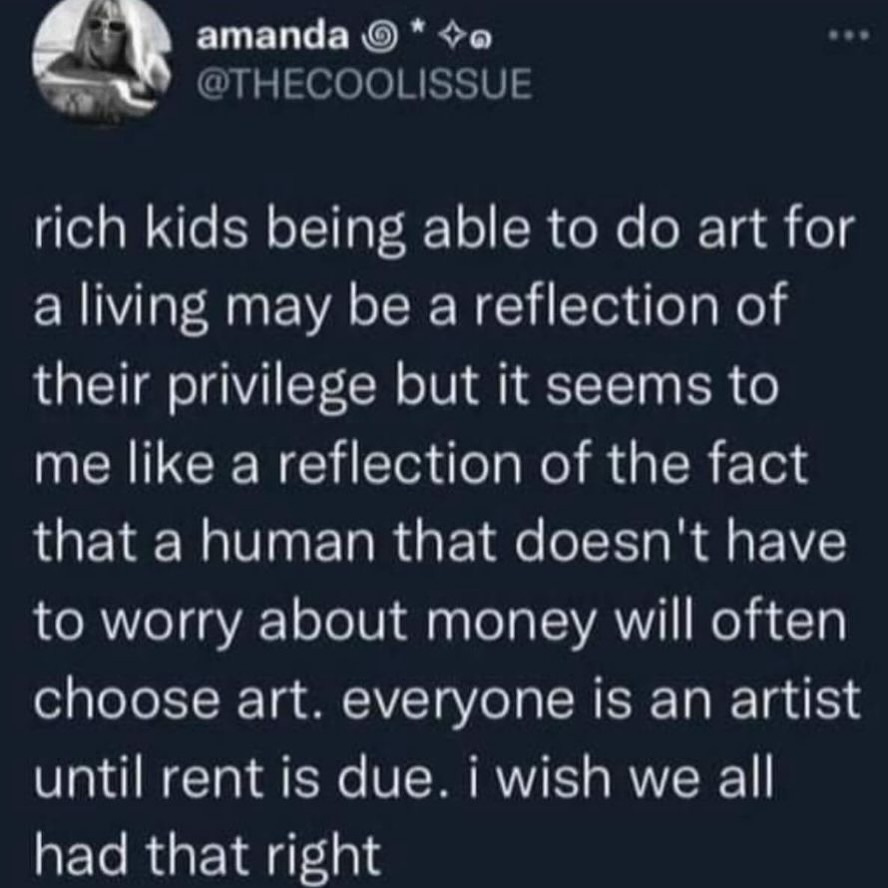
One guy said BI for artists is taking money off ‘families’ to give it to ‘bums’. Another said this scheme was ‘people who work in offices’ paying for ‘artists’, when it should be the other way round. These formulations are really weird. Do these guys actually know any practicing artists? Most artists have families. And to be honest, 95% of artists I know hold down other jobs, ‘working in offices’ or in construction or whatever else they have to do to get properly paid to support their art practice. (Often these two phenomena overlap: if artists have families, they are more likely to have to do these other jobs as well as their art.) The exception to this rule is artists who have a lot of family money or a very rich spouse who is happy to support them (these are both pretty rare, by the way).
As Stephen Riddell pointed out in response to one of my Notes, a lot of non-artists are unable to understand the pathways by which practitioners of art become the kind of artist they consider acceptable / successful (that is, rich: Stephen quoted a builder who praised Peter Jackson as the right kind of artist, one who had ‘got it sorted’). Basically— as with any other skillset— professional development is ongoing, all the way through from initial childish aptitude through to world-rocking mastery. (As longtime readers will know, I’m not a fan of PJ— let’s substitute, say, Jim Jarmusch or Werner Herzog, as comparable examples of commercially successful auteurs.) This touches on my Rockpool Theory of Art: if there are no rockpools for the small fry to practice (learning how to be fish / make art) in before they are washed into the open ocean, none of them will be big, strong, & wily enough to survive the storms & evade predators. (That is, aside from the children of privilege, whose parents can afford to construct artificial rockpools for them to practice in.)17
Biss: “At first, I don’t understand why we need to explain that artists must have time and space to make their art and that this costs money. As champagne is passed around, some conversation clarifies this. The people here believe that if artists are successful then their success should produce all the money they need. And if they aren’t successful then they don’t deserve money.”
Power Allowance
But, in any case, all that is beside the actual point. Art is a bellwether profession; when it comes to the advent of AI, we’re the canaries in the coalmine. Art is often precarious, & it is considered non-essential by many, yet as practitioners of culture at a high level, artists are in some sense an embodied expression of healthy civilisation. A complex social ecosystem is like a jungle, so interwoven in its processes that it’s meaningless to consider a single entity in isolation (much like the economy). Industrialisation is an enclosure, a taming, an imposition of monoculture.18 Practicing art under such farm-like conditions is using the hedge at the field’s edge for a wild corridor. But, like, it’s hard to live in the hedge.
Being a practising artist means I get to be the recipient of people’s feeling about art, artists, & art-making. Mixed in with the praise & appreciation, with the disapproval & mockery, is a strong undercurrent of yearning & envy. There’s a sense of I’m not allowed to, so how come you’re allowed to? And / or It’s stupid anyway. It doesn’t matter. OK, sure, it doesn’t matter. Then why are you so upset? The truth is that many (most) people have deep wounds in the place where their innate creativity was mocked, abused, or hurt.
When Dr Sea arrived in the pub, Kev & I were yarning about economics. Sea works in the field of energy poverty. She had just come from a big conference, & when I said we were talking about UBI, she said “Yes, & people should have a basic energy allowance, too.”19
The conversation swung round to who produces vs. who profits. I was like, actually, that is interesting, because I hadn’t thought about it that way, but I produce; I make something, even though that thing is not a real world object but rather a web of ideas & connections. I labour to spin the web, to bring it into a readable form, & the produced thing is this, what you’re reading.
Let’s take me, then, as a cultural worker. I’m not typical, but that’s part of the point. I work outside any institution, so I lack bona fides; nevertheless, I have made art for my whole adult life. You may not like what I produce— but you can’t deny that I produce it. You may not consider what I do to be ‘proper work’— but in terms of hours worked it is the thing to which I dedicate the majority of my time. This, the thing I can do best, seems to me like the best use of my life. It’s a form of labour that is highly skilled, & furthermore unique. You are at this moment eating the fruits of my labour. You may not like the taste, but even by reading these words you are affirming the value of my work, which is not strictly measurable in dollar terms.20
Fish-Frying Cabinetmakers
Reading Eula Biss some more, I came to the chapter called WORK, where she outlines the difference between ‘Shit Jobs’ & ‘Bullshit Jobs’, according to Anarchist anthropologist David Graeber.
Biss: “Bullshit jobs aren’t shit jobs, the distinction being that shit jobs involve essential work that needs to be done21— what makes them shit is that the workers who do these jobs are badly treated, undervalued, & poorly paid. ‘Shit jobs tend to be blue-collar and pay by the hour,’ Graeber observes, ‘whereas bullshit jobs tend to be white collar and salaried.’ Bullshit jobs are not usually dangerous or physically demanding. And they pay well. But they don’t offer any of the rewards of service or the satisfaction of having done something worth while. Most of them involve doing nothing at all. Where shit jobs often expose a worker’s body to harm, bullshit jobs cause psychological harm.”
Graeber defines a Bullshit Job thus: a form of paid employment that is so completely pointless, unnecessary, or pernicious that even the employee cannot justify its existence, even though, as part of the conditions of employment, the employee feels obliged to pretend that this is not the case.22
The point is that as things stand, a lot of paid work is extraordinarily unproductive. (Conversely, a lot of productive work is unpaid, but that’s a whole other kettle of fish.) This used to frustrate me a lot about menial office work, which I did for over a decade. I could often see where processes could be improved for greater efficiency or elegance, but as the lowest of the low I lacked any power to implement change. I had no choice but to undertake the pointless steps of whichever task again & again. Also, I noticed that there was a natural rhythm to the day (for clock-watching type jobs, not the ones with job satisfaction but the kind people have to force themselves to do— Bullshit Jobs, in other words): 3 p.m. was the time the real slacking-off started. This led me to develop a theory that six hours was the ACTUAL maximum productive time-block, & workplaces would be better to let people go home early. But ideas like this, or like the four-day work week, even though they are pragmatic solutions in terms of both human behaviour & value for money, are more or less heretical in the church of work. (Yes, yes, I’m sure you love your job. But if you don’t have extensive23 lived Bullshit Job work experience, I’m not talking about you.)
So Bullshit Jobs don’t make any economic sense— nevertheless, they are an extraordinarily widespread phenomenon. Graeber: “According to economic theory, at least, the last thing a profit-seeking firm is going to do is shell out money to workers they don’t really need to employ. Still, somehow, it happens… The answer clearly isn’t economic: it’s moral and political. The ruling class has figured out that a happy and productive population with free time on their hands is a mortal danger... And, on the other hand, the feeling that work is a moral value in itself, and that anyone not willing to submit themselves to some kind of intense work discipline for most of their waking hours deserves nothing, is extraordinarily convenient for them.”
Here’s an excellent Bullshit-Job-themed song from Richard Dawson, the opening track off his album 2020. Someone pointed out in the comments that the initial riff is maybe meant to simulate the sound of a photocopier. It took me a few listens to work out exactly which type of work is being described in the song.
Bums
It was Shanty Club night, so I went to the Welsh Dragon. There I ran into my bestie’s bestie Sam, a lawyer, brought up in New York then transplanted here.24 (Only as I’m writing this am I understanding why I have this series of themed conversations in a day: it’s because when people ask me how are you? or what have you been up to? I reply by talking about what I’m writing about.) When we started talking about the UBI, Sam took a strong, lawyerly position, a variant on the billionaires won’t let us tack: “It’s never gonna happen, cause we’re getting robot fascism.”
“Let me play devil’s advocate,” he said. Why would people still wipe bums once they’re getting free money & a robot can do the wiping for them? (The people only work because they get paid tack.)
I said I didn’t think a robot could wipe a bum. “Of course it can!” said Sam.
Anyway, I said, people have always wiped bums.25 In fact, it’s a good example of unpaid labour: people wiping their babies’ bums. Sam said that was different, because they loved their cute little babies. I said maybe if everyone had more time & energy it would be easier for them to care for the other people they loved. (I was assuming we were talking here about old people’s bums, though now that I’m thinking about it, there are other people who need help with this kind of thing, & people care for them: many such cases.)
I had been puzzling over which umbrella this UBI idea fell under. Was it Communist, or just Socialist? Was it Anarchist— but centralised— Anarcho-Syndicalist, then? In the Dispossessed, in Le Guin’s imagined Anarchist society (based largely on the thinking of Peter Kropotkin & Murray Bookchin), she does away with money altogether, & even with ownership. Everything is communal, but everything is also centralised, run by people. Le Guin solves the problem of how to make people do the dirty work by making it semi-obligatory & societally embedded. Kleggich, she calls it, drudgery, & people do it one day out of each decad, each ten-day cycle. There is no term in Pravic26 for someone who takes pride in doing more of this drudgery than others,27 but there is for someone who shuns such grunt-work entirely— anyone is theoretically ‘free’ to do so, but it leads to social opprobrium. (This is a central tension for the protagonist Shevek, a theoretical physicist.)
Andrew Yang, however, whilst running for President in 2020, said that Basic Income (or ‘Freedom Dividend’, his preferred term) is not Socialist, no no! Quelle horreur! It is but the new iteration of Capitalism, where everyone doesn’t start from zero. There’s some truth in that summary, too. If we all have to play this card game to live, why not deal us a few cards?
Sam & I sparred for a long time. My friend Paul the botanist came to the table & joined in the conversation, backing me up, & after a while another woman, a stranger came & sat down with her beer. I asked her if she wanted to participate, but she said she was happy just listening.28 Arguing with Sam was like wrestling with a strong angel of the mind. He kept saying how it was ages since he’d had such a great conversation— he never gets to have these talks! Singing started up in the other room. After a while we were talking about how the first country to implement such a scheme would have to have strong border controls: everyone would want to live there.29 After a while more Sam had his phone out & was calculating how much it would cost, then he said I had convinced him, then we went & sang shanties.
Idealism / Realism
Remembering the bodymind buzz I got from these rigorous debates, I realised how much I’ve missed that feeling. (Is the feeling of stimulating, open, robust debate an endangered species? Part of it what made it good was that it was in person, kanohi ki te kanohi, not on the internet.) It feels good to think & speak freely, it feels good to play with ideas, it feels good to pretend to have hope that things can still be better than they are. I kept saying in my conversations about UBI that maybe it won’t or can’t happen— but that doesn’t mean it wouldn’t work. I think a lot of radical ideas are like this: they’re provocations to free thinking. It’s that Universal bit— the bit that would make it work— that’s the forbidden thought these days. The foot-soldiers of Capitalism will not allow such collectivism to even be thought about: they pour a lot of money into the policing & suppression of such thought, into convincing people that fragmented servitude is awesome. Taboo hides power. There are reasons the fash fear collectivism so much. But, you know, our minds are our own.
Possibility vs. Impossibility… Idealism vs. Realism… Logical vs. Ideological… Intrinsic vs. Extrinsic… Producers vs. Profiteers… Actually, I don’t consider myself an idealist or a Utopian. I’m more interested in trying to work out what’s true. Radicalism to my mind is less about adding layers of complexity, more about stripping away. I reckon it boils down to what you think a human being is. Are we individual or collective animals? If you study history you will see that there are many different ways to be human. If the laws of Capitalism were so ironclad, we would see them play out over & over again across history & prehistory. But that is not the case. Money is a recent invention, & the tech that seeks to rule our lives at every turn is an even more recent invention. The system we are forced to inhabit doesn’t even seem natural to us— by ‘us’ here I mean most of us, the 99%— we just feel that there’s no way out. A lot of effort has to go into keeping people at their bullshit jobs, for instance.30 The major underlying objection to UBI seems to be: what if people didn’t have to do things they hated any more? Which is exactly why I think it’s a good idea. (Let me remind you here that all the Basic Income studies show clearly that people don’t work less given Basic Income; they work differently.)
It’s a variant of that same I don’t get to, so you shouldn’t get to either argument about making art. You know… I would far prefer that everyone else made more art / took more entrepreneurial risks / had more original thoughts. Can you imagine such a world? Did you know that even temporary precarity causes a short-term IQ drop?31 I’d much rather we all levelled up, rather than levelling down. How would society run if we weren’t all forced to do things we hate? Society would collapse! My brother in Christ, society is already collapsing.
Spare a thought for the poor billionaires, said my dream. Obscene wealth used to get you praised, but now it doesn’t. It used to be a steady job, but now everybody hates you! Mobs want your head on a pike! Actually, this is one of the three major cultural shifts I’ve witnessed in my lifetime, the other two being the dawn of the Tech Age & the rise of environmentalism, from a fringe concern when I was a kid to daily weather today. It’s interesting having a few decades under your belt: it proves things change.
Running with Varoufakis
I had been watching a lot of Yanis Varoufakis in the course of my UBI studies. I watched one video where the interviewer asked Varoufakis straight out whether the woman referred to in the Pulp song Common People was in fact his wife? (“She came from Greece, she had a thirst for knowledge, she studied sculpture at Saint Martin’s College…”) Varoufakis smiled & gave a semi-evasive answer that strongly implied she was. Big if true!
Upon investigation, I discovered that Jarvis Cocker has claimed he didn’t know the woman in the song, just met her in the pub. But Varoufakis has previously stated that his wife, sculptor Danae Stratou, was the only Greek woman studying sculpture at Saint Martin’s at the time the song was written. I found this a hilarious & fascinating piece of lore. Both these advocates for the common people were connected in history by the same muse— an artist to boot!
Then I fell asleep & dreamed I was going for a run with Varoufakis. He was way fitter than me, & I felt self-conscious in my borrowed gear, but of course I was going to go! I would just have to keep up as best I could.
Tempting as it was to embed Common People here, I had already decided to add a song by friend & fellow local radical Wizard Lake South. Watching his videos I remembered that Lake is also a runner— many of his videos show him running. I watched them all & decided this one fit best.
It’s just the cost of living here
Get used to it
It’s just the cost of living here
We all pay it
Lente Brat II
As I was finishing this draft,32 Andrei Codrescu published the full post following on from his Note about being a teenager behind the Iron Curtain: NO FUTURE PLEASE. After speaking about history & time, he starts collating literary visions of the future. “The future we’ll never see is an interesting place. The future we might see, will be from the stands. We will watch it go by faster and faster as we recede. When we come to a stop, it will be a blur, a speeding ball of tumbleweed…
This is where we are— staring at the future from the stands. Some of us are applauding. Others are booing. But none of us, fans or hecklers, can see, or even imagine, what it might look like.”
It’s worth listening to him reading it aloud:

The Commons
I kept wanting to add all kinds of caveats & explanations to this essay. Talking about money, even in the abstract, is still taboo, more so rather than less in times of austerity (like now) when people are experiencing higher levels of personal scarcity. (Remember that drop in IQ begotten by precarity?) I don’t fancy fighting, but ultimately it’s pretty simple: I think I’m right. Studies have shown again & again that Basic Income doesn’t make people more lazy but less lazy— though it does make them change what they work at, which to me is further proof of concept. Studies have shown that BI improves quality of life, boosts the economy, returns more profit than loss. The current improbability of enacting such a policy, as I have repeatedly said, is not a question of affordability, but lack of political will. (But even that is not universal: the fact that reputable countries like Ireland, Finland, & Germany take the idea seriously enough to fund studies on Basic Income proves its feasibility.) It’s also interesting to note that while UBI is still seen as fringe, it’s a bilateral theory— it’s not just leftists who see UBI as a good idea.
Guy Standing said in one video I watched that “every single rebellion we’ve had in our history [he’s English] has been an attempt to recover the Commons. The Peasants Revolt in 1381; Kett’s Rebellion in 1549; the Levellers and the Diggers of the 1640s; the Luddites in the early nineteenth century; and it goes all the way through the nineteenth century, with the Chartists and so on, until the ultimate defeat, in the form of William Morris… who wanted everybody to have the right to work, and the right to exist in the Commons… [Then] the Communists and the Christian Democrats: one said ‘the State should take it over’; the other said ‘the market should take it over’. And the debates through the twentieth century ignored the Commons. But it goes back to that sense of justice which I think is fundamental.”
Who owns the Commons? Do human beings have a right to life, a right to a living? Is profit moral? Do we all have a right to a share of the profit extracted from that which belongs to all of us? Why is some labour paid, & other labour unpaid? How can what is unbalanced be rebalanced? (Rebalancing does occur, historically speaking, one way or the other.) These are deep questions. But one thing’s for sure— business-as-usual is already over. Maybe it’s a crazy time to be considering radical ideas. But maybe it’s not crazy at all: if not now, then when? The old agreements are broken. Just look around you to see the effects of deepening economic inequality. UBI theory is not just pie in the sky— it’s a pragmatic solution to worsening problems that affect all of us.
Eula Biss, Having and Being Had. She is referring to Elizabeth Magie’s Landlord’s Game of 1903, designed to illustrate the theories of Henry George, who believed that profits from a natural resource should be distributed equally. Biss: “[Magie] hoped that children who played her game would grow up understanding the injustice of our economic system. To help illustrate this injustice, she designed two sets of rules. Following one set of rules would create an equal distribution among players, with no winner. Following the other rules would create an accumulation of wealth, allowing one player to win. The rules that survived, the rules we still play by, are winner takes all.”
Magie’s patents were violated, the game was stolen, the first set of rules were dropped, & it mutated into the game we now know as ‘Monopoly’. Public Domain Review - The Landlord's Game: Lizzie Magie and Monopoly's Anti-Capitalist Origins (1903)
Ursula K. Le Guin, The Dispossessed. The full quote goes: ‘A thin, small, middle-aged man beside Trepil began speaking, at first so softly, in a voice hoarsened by the dust cough, that few of them heard him. He was a visiting delegate from a Southwest miners’ syndicate, not expected to speak on this matter. “…what men deserve,” he was saying. “For we each of us deserve everything, every luxury that was ever piled in the tombs of the dead kings, and we each of us deserve nothing, not a mouthful of bread in hunger. Have we not eaten while another starved? Will you punish us for that? Will you reward us for the virtue of starving while others ate? No man earns punishment, no man earns reward. Free your mind of the idea of deserving, the idea of earning, and you will begin to be able to think.” They were, of course, Odo’s words from the Prison Letters, but spoken in the weak, hoarse voice they made a strange effect, as if the man were working them out word by word himself, as if they came from his own heart, slowly, with difficulty, as the water wells up slowly, slowly from the desert sand.’
Here:
When I was looking into the BI for Artists thing I noticed a link in the sidebar pertaining to Basic Income Support for Sustainable Farmers (BISS), & clicked through to investigate. As far as I can tell, BISS has twin aims: supporting farmers through periods of patchy income, & rewarding them for farming in a more environmentally conscious fashion. I found it interesting that to qualify, you don’t have to own the land, just work it: according to the guidelines, ‘An active farmer is a person that manages or farms land.’
This morning I came across this explainer of the figures: “[A]n external report by UK-based consultants Alma Economics… found that the pilot cost €72 million to date but generated nearly €80 million in total benefits to the Irish economy. The report also found that recipients’ arts-related income increased by more than €500 per month on average, income from non-arts work decreased by around €280, and reliance on other social programs declined, with participants receiving €100 less per month on average.”
So my guess is that the 1.46 return for 1 invested figure quoted by Rodney Owl = the increased GDP + the decreased social spending: that is, not so much what the Government ‘got back’ as what it got back plus what it didn’t pay out. I may be wrong, but even if I am, the financial outcome of the study is still in the black.
Here:
By these criteria I would probably not qualify
I didn’t used to give a fuck about economic thinking— I was kind of allergic to it— but lately I’ve become more interested. I recommend Brett Scott’s excellent & accessible Stack ASOMOCO: he’s great at explaining economics from an anthropological perspective— that is, based on how humans actually behave as interconnected entities.

Kev says: “GST is only reclaimed in transaction of real goods & services, and only bottom-level actors i.e. wage earners pay GST on everything. Businesses reclaim GST on inputs and charge it on outputs, so the amount they actually return to the government is proportional to the value they add to the non-wage inputs.”
However, those in higher tax brackets would give more of their UBI back in tax— just like the pension.
A good explainer on MMT here, from Brett Scott:

I agree with much of what Scott says here, particularly his statements at the end about individualism being a Neoliberal illusion, as demonstrated by this amgery comment I wrote on Mountain Tūī’s post whilst in my UBI-stan era (AKA the other day):
I jest, but only just
Sorry about this all meta-posting, but the conversation is different there, & I know it doesn’t necessarily cross the blood-brain barrier over to here, newsletter-world
I understand this point of view too. The youth are no fools, they see how things are playing out
Dougald Hine’s good phrase for the antidote to this monoculturisation is ‘Regrowing a Living Culture’; as if we were sourdough or sauerkraut, needing probiotics— reinoculation with wild yeasts— for a robust bioflora.
i.e. a certain amount of free kilowatts per day. This is how some rural councils run the distribution of water: a certain amount free per day, then above a certain volume it begins to cost. It’s a neat way of dividing personal from commercial usage & in principle it’s a similar idea to the UBI. You can do more than the basic, but it won’t be free.
My friend Josh, one of the few artists I know who makes a proper living from his work, says that his accountant calls likes, shares, etc. “vanity metrics”. However, I think it’s also true that attention is a kind of currency— that’s why we ‘pay’ it.
If you want to understand more about the intersection of the money economy & the gift economy (under which much art-making operates), I recommend The Gift by Lewis Hyde. “Even if we have paid a fee at the door of the museum or concert hall, when we are touched by a work of art something comes to us which has nothing to do with the price… The daily commerce of our lives— ‘sugar for sugar and salt for salt,’ as the blues singers say— proceeds at its own constant level, but a gift revives the soul… if it is true that in the essential commerce of art a gift is carried by the work from the artist to his audience, if I am right to say that where there is no gift there is no art, then it may be possible to destroy a work of art by converting it into a pure commodity. Such, at any rate, is my position.”
AKA ‘kleggich’: more on this shortly
A more detailed taxonomy of Bullshit Jobs here: ‘I had to guard an empty room’: the rise of the pointless jobs
Freudian typo here: ‘expensive’
The funniest bit of our conversation was Sam’s very accurate impression of the Prime Minister, for which he put on a thick ‘Koiwoi’ accent by pushing his lips out like a chimpanzee
Bum-wiping is way older than Capitalism
The language constructed along with the Anarchist society. “Most Defense work was so boring that it was not called work in Pravic, which used the same word for work and play, but kleggich, drudgery.”
AKA a Stakhanovite: like the drafthorse Boxer in Animal Farm
Later she sang Chicken on a Raft, a song I also sometimes sing
Economist Guy Standing (who coined the term ‘Precariat’), a long-time advocate of Basic Income, says he prefers the term ‘Unconditional Basic Income’ to ‘Universal Basic Income’— meaning that for pragmatic reasons it would be accessible only to citizens of a country; though he also says that if he were a ‘Philosopher-King’ he would grant it to everybody in the world simultaneously.
See also: ye Patriarchy… If it’s so natural, why the need for constant brainwashing & coercion? Speaking of which, I noticed that most of the people I quoted in this piece were menfolk. Not sure why that is exactly: is money a man-thing?
This data is from a study of Indian farmers, who get paid only once a year: they tested IQ before & after the harvest & found an IQ difference of ~13 points. (Source: Guy Standing)
Herman Melville, Moby-Dick: “God keep me from ever completing anything. This whole book is but a draught—nay, but the draught of a draught. Oh, Time, Strength, Cash, and Patience!”
Thanks Rosie. Yes to it all. I find it hard to engage with any desire for anything other than cultures of care and connection - which means I basically don't engage much with any conversations in this realm, it feels so far from the vision which drives me on. And I decided that other people seem quite willing to get stuck in with addressing the nuts and bolts and the steps we might need to begin taking, on this systemic level, so it feels like a better use of my energy to concentrate on embodying something different. Or perhaps, in other words, contributing to these conversations in languages and modes other than those of oppression, which also are designed to massively fuck with certain parts of us, and prioritise others, so that the conversations are always dragged towards certain black holes. And there is something here about reason vs art... it's great to read you dancing across that line and starting to suture the wounds of that particular binary.
Here's a basic idea: our system makes it very difficult for people to express themselves well - honestly, openly, appropriately, and with emotion. So much has to be hidden, or forgotten about, because it isn't acceptable, or there isn't time, or there aren't the right ears to listen - one of the things about healthy expression is how it connects; the individual expressing is a link, and a portal, and the act of expressing is constantly creating and being created by its context. An 'Artist' is a kind of professional expresser, who takes on the burden of expressing as part of a collective which, in devoting less and less attention to this, creates an ever bigger logjam of the unexpressed. Which is sickness, in the bodies of individuals, relationships, societies, the earth and all of its beings.
In the right cultural context, all expression holds value as truth. But there's such strong conditioning around the idea of truth, and such strong armour around the wounds here, that I suspect this will all have to be embodied in somewhat mysterious ways, just as much as laid out in clear and rational arguments (what could be more rational than doing whatever it takes to get everyone healthy? rationalism and people convincing themselves they are behaving rationally is one of the biggest con jobs ever pulled off, IMO)
a few additional thoughts
1. what is the cost of loving?
2. there will still be bums needing wiping long after capitalism itself has been wiped
3. the only thing that ever trickles down is the tiny dribble of blood from the corner of the vampire's mouth
I'm glad you highlighted the existence of shit jobs, and the driving need for the U in UBI. I think you deserve BI as an artist, that this would be a benefit to society. But I also think that the person who served your phở deserves BI, and the person who made it, and the person who cleans the toilets at the restaurant, and the person who washes the dishes, and the grocery workers and farmers who got the ingredients to the restaurant, and, and, and.... BI for artists is a great start, and I agree with all the reasons you write that artists are a good demographic for the first bits of incremental change. But I don't really love the idea that an artist might be eligible for BI, while all the precarious shit-job workers performing vast amounts of skilled labour that helps support that artist are not going to receive BI any time soon, and that their contribution to how art gets made is often elided.